Contents15
- Quick reference by stream type
- Picks by stream type
- Solo game streams, or solo talk streams in a noisy room
- Solo talk streams in a quiet room, or two people facing each other
- Singing
- Condenser vs dynamic, and pickup patterns
- Room noise and noise reduction
- Singing and the headphone output
- Do you need a mic arm or pop filter?
- FAQ
- What’s the best mic for streaming?
- Should I pick a condenser or dynamic mic for game streaming?
- What mic should I use if my keyboard is loud on stream?
- Can I sing on stream with a USB mic?
- Does a more expensive mic sound better?
For solo game streams, or solo talk streams in a room with keyboard and fan noise, pick a mic whose maker describes reducing that noise. For solo talk streams in a quiet room, or two people facing each other, pick one that switches between mainly front pickup and front-and-back pickup. For singing, pick one whose maker says you can hear yourself without delay through the mic’s headphone output.
This guide isn’t based on testing the mics. It’s a read of the makers’ official material, sorted by the specs to look for.
Quick reference by stream type
Find the row that matches your stream. The rows are this guide’s own grouping from official material. The right columns show the spec to look for and the pickup pattern (the direction a mic listens).
The table covers one person, or two people facing each other; groups of three or more aren’t covered. The picks are in the next section.
| Stream type | Spec to check | Pattern to use |
|---|---|---|
| Game streaming (solo) | Official description of reducing keyboard, click and fan noise | Cardioid |
| Talk stream (solo, keyboard or fan noise in the room) | Official description of reducing keyboard, click and fan noise | Cardioid |
| Talk stream (solo, quiet room) | Both cardioid and bidirectional | Cardioid |
| Talk or game stream (two people facing each other) | Both cardioid and bidirectional | Bidirectional |
| Singing | Official mention of hearing yourself without delay via the mic’s headphone output | Cardioid |
Picks by stream type
Each pick is a current USB mic from a major maker that meets the condition for its stream type in the maker’s official material. Listings had to have 100+ ratings, 4+ stars, be new, and be sold by Amazon or the brand. The talk-stream and singing picks are the cheapest that qualify, and one model fills both slots; for game streaming, only one model met the condition in official material.
Solo game streams, or solo talk streams in a noisy room
The maker officially describes features that reduce keyboard, click and fan noise. It’s new, so the ratings bar was waived for its new listing sold by Amazon.
It has only 32 ratings so far.
Solo talk streams in a quiet room, or two people facing each other
It switches between cardioid and bidirectional patterns.
Singing
Its official page says you can monitor your voice latency-free through the headphone output. It’s the same model as the talk-stream pick.
Based on Amazon.com listings checked on November 3, 2026, the game-stream pick cost about 1.6 times the talk-stream pick, which is also the singing pick. Check the current price on each listing.
Condenser vs dynamic, and pickup patterns
No official source found says whether a condenser or a dynamic suits game streaming better, so this guide chooses by noise reduction and pickup pattern instead. Shure’s explainer describes dynamics as simple in construction, rugged and almost impossible to overload.
According to Shure’s explainer, cardioid is the most widely used pattern and is least sensitive directly behind the mic. Bidirectional picks up front and back, for two sources facing each other. So cardioid suits one person and bidirectional suits two people facing each other.
Neither Shure’s nor RØDE’s polar-pattern explainer gives a speaking distance.
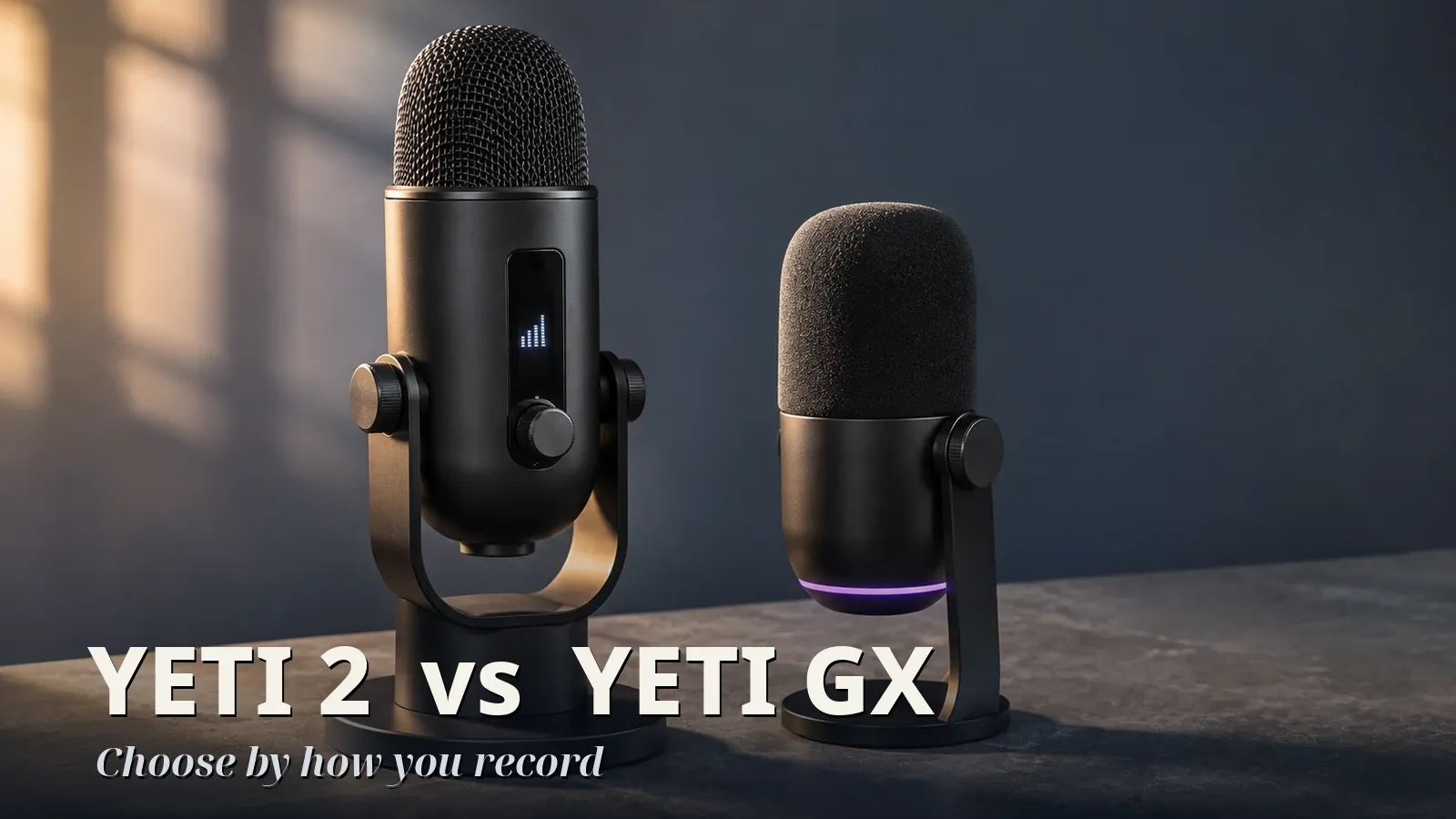
The Yeti GX, a dynamic mic, meets the listing rules on Amazon.com but fits none of the three slots. It’s supercardioid only, with no official mention of keyboard or fan noise reduction or a headphone output. A separate guide compares it with the YETI 2.
Room noise and noise reduction
According to Logitech’s setup guide, the YETI 2 has three De-Noise levels. Level 2 also reduces keyboard and mouse clicks, and level 1 targets light noise such as a CPU fan. The guide also notes it can affect voice quality.
A cardioid pattern is least sensitive directly behind the mic. The sources give no figure for how much keyboard noise this cuts and no official placement advice.
Singing and the headphone output
For singing streams, pick a mic whose maker says you can hear yourself without delay through the mic’s headphone output, called zero-latency monitoring.
According to Logitech’s setup guide, the game-stream pick, the YETI 2, delays what you hear in the headphones by 20 ms in its standard mode. Realtime mode removes the delay but turns off the denoiser in the headphones.
Whether PC audio also comes through that jack wasn’t clear from official material, so check with the maker before buying.
Setups using XLR with an audio interface weren’t covered here. All picks are USB mics that plug into a computer.
Do you need a mic arm or pop filter?
No official source found says you need an arm or a pop filter from day one. An arm can be added later if the mic’s bottom thread fits it.
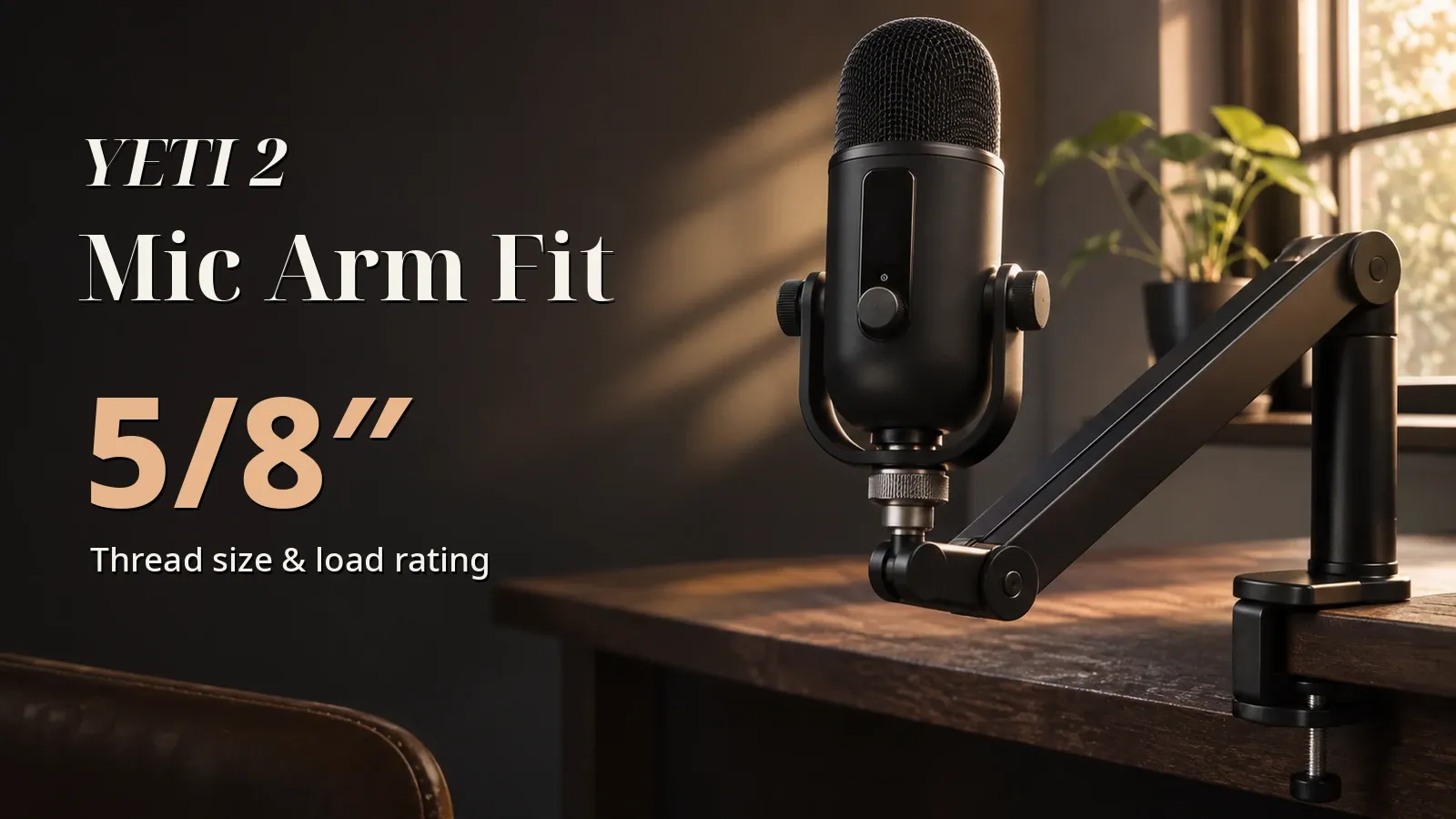
The game-stream pick officially takes a 5/8” arm thread. Official material doesn’t give the thread size for the talk-stream and singing pick.
The game-stream pick’s 995 g (about 2.2 lb) includes the stand, and there’s no official weight for the mic alone. Some arms need a thread adapter, which isn’t included.
A pop filter sits in front of the mic to soften bursts of breath on P and B sounds. Shure says its own pop filter attenuates breath noise and plosives and clamps to most stands, with no figure for how much.
The game-stream pick, the YETI 2, also has a De-Popper that lowers the momentary level of plosives. There’s no figure for how much, and no official word on whether it replaces a pop filter.
FAQ
What’s the best mic for streaming?
Decide by stream type and room noise. Solo game streams and noisy rooms call for noise reduction.
Quiet solo talk streams and two people facing each other call for switchable patterns, and singing for a headphone output with no monitoring delay.
Should I pick a condenser or dynamic mic for game streaming?
Choose by features, not by type: this guide’s game-stream pick is a condenser, picked for keyboard and fan noise reduction. No official source found says whether a condenser or a dynamic suits game streaming better.
What mic should I use if my keyboard is loud on stream?
Pick a mic whose maker officially describes reducing keyboard and fan noise.
Can I sing on stream with a USB mic?
Pick a USB mic whose maker officially says you can hear yourself without delay through its headphone output. This guide didn’t compare XLR setups.
Does a more expensive mic sound better?
No official source found ties price to sound, so this guide chooses by features.
Related guide:
Data and formulas used (for verification)
How this was checked: As of November 3, 2026, the makers’ official specs and the Shure and RØDE explainers were checked and sorted. The data is in the “Data and formulas” section at the end of this guide.
Method
- Covers USB microphones from major makers (Logitech G, RØDE, Shure, HyperX, Elgato, Audio-Technica and others) per their official specs and setup guides, and Amazon.com listings, as of November 3, 2026. No microphone was tested in hand.
- Figures, capsule type, polar patterns and features come from makers’ official material only. Retailer listings and review sites are treated as no official figure and are not used for slot conditions. No third-party measurements are used.
- How stream types map to slots (this guide’s own grouping): singing → a model whose official material says you can hear yourself without delay through the mic’s headphone output (the original Yeti’s product page says latency-free, and the YETI 2 setup guide says Realtime mode removes its 20 ms monitoring delay; no delay mention was found for the QuadCast 2); two people facing each other → cardioid and bidirectional both in the official specs; solo game streams, or solo talk streams in a room with keyboard or fan noise → a model whose maker officially describes reducing keyboard, click and fan noise; solo talk streams in a quiet room → cardioid and bidirectional both listed.
- Condenser vs dynamic follows only what was checked word for word in Shure’s explainer (dynamics are rugged and hard to overload). Polar patterns follow Shure and RØDE, and noise reduction and auto-tracking follow Logitech’s setup guide. No source gives figures for how well these work.
- Picks are the cheapest models that meet the slot condition in official material and whose Amazon listing has 100+ ratings, 4+ stars, is sold by Amazon or the brand, and is new (checked November 3, 2026). The YETI 2 is new and has few ratings (32 on Amazon.com, checked November 3, 2026), so the ratings bar was waived for its new listing sold by Amazon.com.
- Not checked: XLR plus an audio interface, what the headphone jack carries (your own voice, PC audio), and speaking distance (no official figure).
Official values for the USB mics checked (US rows; retailer listings count as no official figure)
| Model | Type (official) | Polar patterns (official) | Keyboard/fan noise reduction described | Headphone jack on the mic | Zero-latency monitoring described | Source |
|---|---|---|---|---|---|---|
| Logitech G Blue Yeti 2 (YETI 2) | Condenser | Cardioid, Supercardioid, Hypercardioid, Bidirectional, Omnidirectional, Stereo | Yes (official) | Yes (official) | Yes (official) | support.logi.com |
| Logitech Blue Yeti (original) | Condenser | Cardioid, Bidirectional, Omnidirectional, Stereo | No official figure | Yes (official) | Yes (official) | support.logi.com |
| RØDE NT-USB+ | No official figure | No official figure | No official figure | Yes (official) | Yes (official) | rode.com |
| Logitech G Yeti GX | Dynamic | Supercardioid | No matching mention (official) | No matching mention (official) | No matching mention (official) | support.logi.com |
| Shure MV7+ | No official figure | No official figure | No official figure | No official figure | No official figure | — |
| HyperX QuadCast 2 | No official figure | Cardioid, Bidirectional, Omnidirectional, Stereo | No official figure | Yes (official) | No matching mention (official) | hyperx.com |
| Elgato Wave:3 MK.2 | No official figure | No official figure | No official figure | No official figure | No official figure | — |
| Audio-Technica AT2020USB-X | Condenser | Cardioid | No official figure | No matching mention (official) | No matching mention (official) | audio-technica.com |
| Elgato Wave Neo | No official figure | No official figure | No official figure | No official figure | No official figure | — |
| Logitech Blue Yeti Nano | No official figure | No official figure | No official figure | No official figure | No official figure | — |
| FIFINE K669B | No official figure | No official figure | No official figure | No official figure | No official figure | — |
| FIFINE AmpliGame A6V | No official figure | No official figure | No official figure | No official figure | No official figure | — |
| MAONO DGM20S | No official figure | No official figure | No official figure | No official figure | No official figure | — |
| TONOR USB microphone (no model number in the listing) | No official figure | No official figure | No official figure | No official figure | No official figure | — |
| Razer Seiren V3 Mini | No official figure | No official figure | No official figure | No official figure | No official figure | — |
| HyperX QuadCast 2 S | No official figure | No official figure | No official figure | No official figure | No official figure | — |
- Type and patterns for the YETI 2, original Yeti and Yeti GX come from Logitech’s support specs; the YETI 2’s noise reduction from its setup guide. The YETI 2’s 995 g (about 2.2 lb) and 288.97 x 110 x 125.26 mm (about 11.4 x 4.3 x 4.9 in) are for the mic with its stand (support spec: “Microphone with stand”). The Yeti GX support spec gives 616 g (about 1.4 lb) and a height of 170 mm (about 6.7 in). QuadCast 2 patterns, headphone output and thread are from HyperX’s product page; NT-USB+ zero-latency monitoring from RØDE’s product page.
- Monitoring without delay: the original Yeti’s product page on logitechg.com says “latency-free”. The YETI 2 setup guide says monitoring is delayed 20 ms in standard mode, and Realtime mode removes the delay but turns off the denoiser in the headphones; this guide counts that as meeting the singing condition. No mention of monitoring delay was found on the QuadCast 2 product page. Pick prices and ratios (Amazon.com, checked November 3, 2026; the body shows ratios only)
| Pick | ASIN | Price | Stars / ratings | Ratio to the talk-stream pick |
|---|---|---|---|---|
| Logitech G Blue Yeti 2 (YETI 2) | B0H8BBT28N | $159.99 | 4.3 / 32 | 159.99 ÷ 99.99 ≒ 1.600 → about 1.6x |
| Logitech Blue Yeti (original) | B01LY6Z2M6 | $99.99 | 4.6 / 57184 | 1 |
| Logitech Blue Yeti (original) | B01LY6Z2M6 | $99.99 | 4.6 / 57184 | 99.99 ÷ 99.99 ≒ 1.000 → about 1x |
- Unless noted, “no official mention” means it was only on a retailer listing or not in the official material retrieved.
- Game streaming slot, left out: Logitech Blue Yeti (original): no official mention of keyboard/fan noise reduction; RØDE NT-USB+: no official mention of keyboard/fan noise reduction; Logitech G Yeti GX: its official noise-reduction description doesn’t mention keyboard or fan noise; Shure MV7+: no official mention of keyboard/fan noise reduction; HyperX QuadCast 2: no official mention of keyboard/fan noise reduction; Elgato Wave:3 MK.2: no official mention of keyboard/fan noise reduction; Logitech Blue Yeti Nano: no official mention of keyboard/fan noise reduction.
- Talk streams slot, left out: Logitech G Blue Yeti 2 (YETI 2): meets the condition and listing rules, but a cheaper pick was chosen (it is the game-stream pick); RØDE NT-USB+: no official mention of polar patterns; Logitech G Yeti GX: the official patterns don’t match (Supercardioid); Shure MV7+: no official mention of polar patterns; HyperX QuadCast 2: meets the condition and listing rules, but a cheaper pick was chosen; Elgato Wave:3 MK.2: no official mention of polar patterns; Logitech Blue Yeti Nano: no official mention of polar patterns.
- Singing slot, left out: Logitech G Blue Yeti 2 (YETI 2): meets the condition and listing rules, but a cheaper pick was chosen (it is the game-stream pick); RØDE NT-USB+: meets the condition and listing rules, but a cheaper pick was chosen; Logitech G Yeti GX: no headphone output on the mic in its official specs; Shure MV7+: no official mention of hearing yourself without delay through a headphone output on the mic; HyperX QuadCast 2: has an official headphone output, but no official mention of monitoring without delay was found; Elgato Wave:3 MK.2: no official mention of hearing yourself without delay through a headphone output on the mic; Logitech Blue Yeti Nano: no official mention of hearing yourself without delay through a headphone output on the mic.
- Official specs weren’t retrieved for FIFINE K669B, FIFINE AmpliGame A6V, MAONO DGM20S, TONOR USB microphone (no model number in the listing), Razer Seiren V3 Mini, HyperX QuadCast 2 S, so they were left out of every slot.
- Not checked: XLR with an audio interface, whether PC audio also comes through the headphone jack, the thread size of the original Yeti and NT-USB+, speaking distance (no official figure), and whether the note on the original Yeti’s support page about Logitech Options support ending and the warranty applies to listings sold today.
Official values used
| Item | Value | Source | Checked |
|---|---|---|---|
| YETI 2 995 g is microphone with stand (official support spec) | Logitech’s support spec lists ‘Microphone with stand weight: 995 g’. 995 g includes the stand; the official pages checked give no microphone-only weight. Dimensions are also for the microphone with stand (288.97 x 110 x 125.26 mm). For arm payload checks the body alone is lighter but has no official figure (use 995 g to be safe). | support.logi.com | 2026-11-03 |
| YETI 2 bottom thread is 5/8”-27; 5/8” boom arm compatible | The support spec lists ‘5/8”- 27 thread at the bottom’ and ‘5/8” boom arm mount compatible’. The setup guide says a thread adapter may be required depending on the boom arm and is not included. | support.logi.com | 2026-11-03 |
| YETI 2 AI de-noiser: officially described scope (fans, keyboard/mouse clicks; plosives not mentioned) | Setup guide De-Noise: 3 levels, ML-trained model to separate voice from noise. Level 1 reduces light background noise like CPU fans; level 2 also reduces keyboard and mouse clicks; level 3 is heavy reduction of all non-voice content; some settings may affect voice quality. The De-Noise description does not mention plosives. | logitech.com | 2026-11-03 |
| YETI 2 De-Popper (Signal Cleanup) is separate from the AI denoiser and reduces plosives | Setup guide Signal Cleanup (Blue VO!CE onboard DSP) has De-Esser, De-Popper, Gate, Compressor, High Pass, Limiter, each switchable on the mic, fine settings in G HUB. De-Popper ‘reduces volume of bursts of plosive sounds like those made by P or B’. It is separate from the AI De-Noise. No official figure for effectiveness; no official statement on replacing a physical pop filter was found. The guide also says to speak into the side of the mic, not the top. | logitech.com PDF Signal Cleanup / De-Popper | 2026-11-03 |
| YETI 2 voice proximity sensor and what it auto-adjusts | Setup guide: with Autogain and/or Auto Tracking on, the sensor measures distance and location to adjust gain, EQ and polar pattern in real time. 90 degree field of view in front; works best with one person; Autotracking does not work in omnidirectional or figure 8. Manual gain target zone -18 to -6. | logitech.com PDF | 2026-11-03 |
| YETI 2 stores presets on the mic; Blue VO!CE runs on the device | Setup guide: Blue VO!CE processing runs on the Yeti 2 itself, G HUB not required; up to 5 onboard presets (P1 Default denoiser level 2; P2 Yeti Classic stereo, denoise off; P3 Gaming denoise 3; P4 Podcast denoise 1, cardioid). | logitech.com PDF | 2026-11-03 |
| YETI 2 capsules, patterns and sample rate (support spec) | Support spec: 3 x 14 mm condenser; patterns Automatic, Supercardioid, Hypercardioid, Cardioid, Bidirectional, Omnidirectional, Stereo, Custom; 48kHz; M/N AU0203. | support.logi.com | 2026-11-03 |
| YETI 2 is sold on Logitech G US store (name YETI 2) | US store page: ‘YETI 2’, black only shown, in stock. Spec table not retrievable; US SKU and launch date not found. Support spec (global) gives M/N AU0203. | logitechg.com | 2026-11-03 |
| YETI GX official specs | Support spec: 616 g (stand not specified), 1/4”-20 mic thread, supercardioid, 1 dynamic capsule, 48-96 kHz, 50 Hz-18 kHz, height 170 mm. US store: dynamic capsule with supercardioid; G HUB Blue VO!CE and two LIGHTSYNC RGB zones. No mention of shock mount/pop filter/boom arm on the retrieved page. | support.logi.com | 2026-11-03 |
| Original Yeti official specs | Support spec: mic 1.2 lb (0.55 kg) and stand 2.2 lb (1 kg) listed separately; 3 x 14 mm condenser; Cardioid, Bidirectional, Omnidirectional, Stereo; 48 kHz; 16-bit; USB 2.0/3.0; thread not listed. | support.logi.com | 2026-11-03 |
| Polar patterns explained (Shure and RØDE) | Shure and RØDE explainers on omni, cardioid, supercardioid, hypercardioid, bidirectional. Neither gives a speaking-distance figure. | shure.com | 2026-11-03 |
| Condenser vs dynamic (Shure) | Shure (page text checked word for word on 2026-11-03): dynamics are “economical and rugged” and “almost impossible to overload”. The page doesn’t say which type suits game streaming. | service.shure.com | 2026-11-03 |
| Pop filter vs windscreen (Audio-Technica, Shure) | Audio-Technica says windscreens ‘are usually made from a foam material and are designed to fit snugly over the microphone element casing,’ and that windscreens and pop filters ‘can often be used interchangeably to accomplish the same task.’ Shure says its PS-6 ‘attenuates unwanted breath noise and plosives and can be clamped to most stands.‘ | shure.com | 2026-11-03 |