Contents18
- Power bank size by use
- Why a power bank charges less than its label says
- Charging more than a phone
- Charging a laptop
- Taking a power bank on a plane
- How to check your own devices
- Picks by situation
- For a small top-up in the evening
- For a normal day
- For travel with two phones
- For charging a laptop too
- FAQ
- How many times can a 10,000mAh power bank charge my phone?
- Should I get a 5,000, 10,000 or 20,000mAh power bank?
- Why doesn’t a power bank charge my phone as many times as its label says?
- How many Wh is a 20,000mAh power bank?
- What wattage do I need to charge a laptop?
- Can I bring a power bank on a plane?
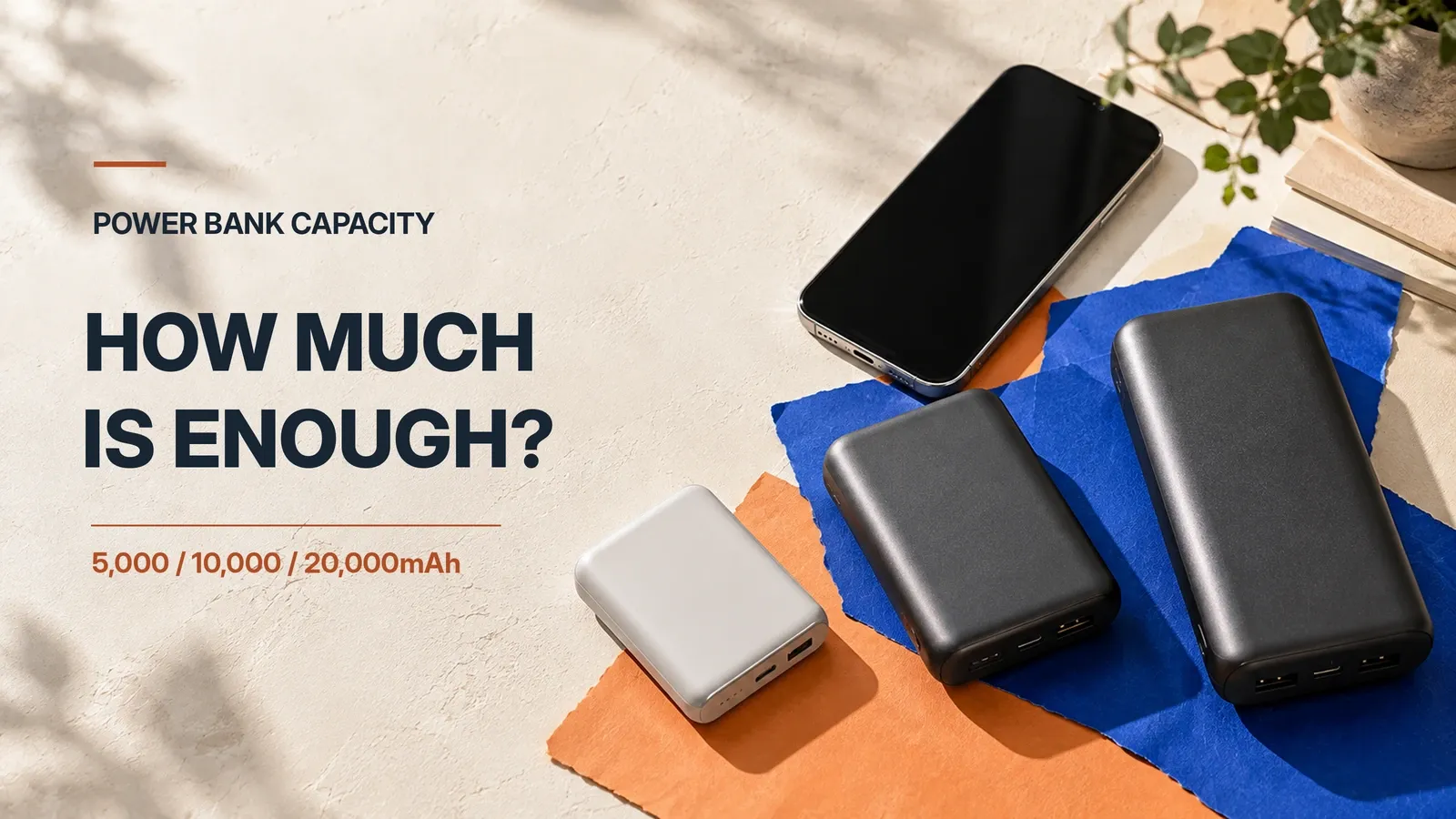
5,000mAh is for an emergency top-up, 10,000mAh for a normal day, and 20,000mAh for travel (if you can recharge each night) or two phones. With a large-battery phone, one charge from 10,000mAh and two from 20,000mAh are just barely enough, and 25,000mAh just barely covers one MacBook Air 13-inch charge. For a laptop, this article picks banks with 65W or more output.
Power bank size by use
Pick 5,000mAh for a top-up and 10,000mAh for one phone charge. Assuming 60-70% efficiency and a 0% to 100% charge, here is how to pick by use.
The travel rows assume you charge the power bank itself every night.
The mAh figure is the battery’s size, and Wh (watt-hours) lets you compare batteries across devices. Conversion efficiency is the share of the energy that arrives instead of turning into heat while charging.
| Use | Size | Charge from 0% |
|---|---|---|
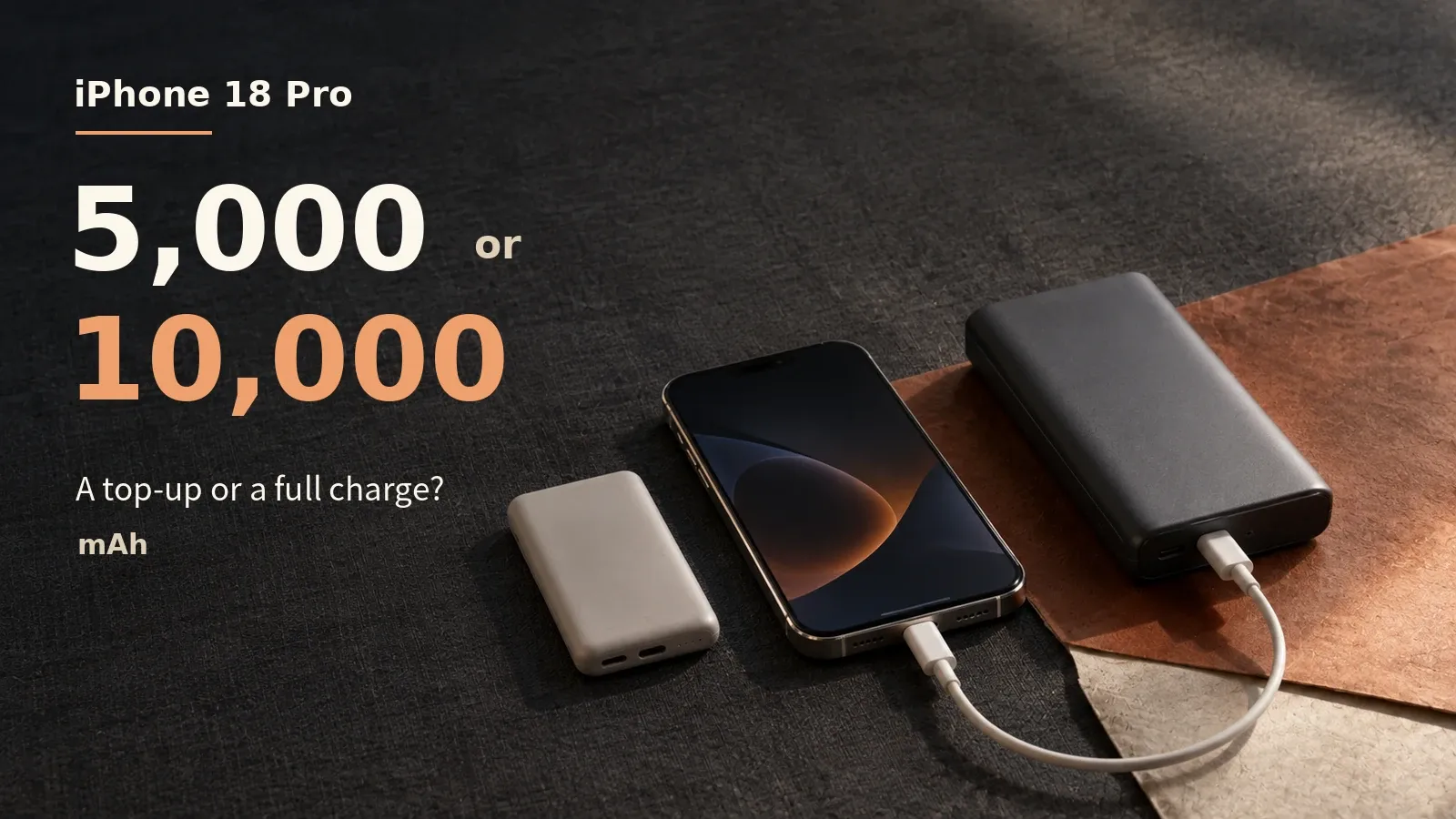
| Emergency top-up | 5,000mAh | About 52-92% of a phone (not a full charge on the phones checked) |
| A normal day | 10,000mAh | About 1.0-1.8 phone charges (1 charge just barely for a large battery) |
| Travel (recharging each night), or two phones | 20,000mAh | About 2.0-3.6 phone charges (2 just barely for a large battery), or 2 phones once each, just barely |
| Charging a laptop too | 25,000mAh (65W+ output) | MacBook Air 13-inch: about 80-100% from 20,000mAh, 1 charge just barely from 25,000mAh |
“Just barely” means the math reaches the charge with less than 10% to spare. The large-battery phone is the iPhone 18 Pro Max, using reported EU label figures for SIM-tray models. eSIM-only models reportedly have bigger batteries, which isn’t checked, so a “just barely” result could change for the models sold in the US.
For a closer look by device, use the next table.
| Size | Phone (iPhone 18 Pro, the smallest battery of the phones checked) | Phone (iPhone 18 Pro Max, the largest battery of the phones checked) | Tablet (iPad Air 11-inch) | Handheld console (Nintendo Switch 2) | Laptop (MacBook Air 13-inch) |
|---|---|---|---|---|---|
| 5,000mAh | About 69-92% | About 52-69% | About 37-46% | About 53-71% | About 20-25% |
| 10,000mAh | About 1.3-1.8 charges | About 1.0-1.3 charges (1 charge just barely) | About 74-93% | About 1.0-1.4 charges (1 charge just barely) | About 40-50% |
| 20,000mAh | About 2.7-3.6 charges | About 2.0-2.7 charges (2 charges just barely) | About 1.4-1.8 charges | About 2.1-2.8 charges | About 80-100% |
| 25,000mAh | About 3.4-4.6 charges | About 2.6-3.4 charges | About 1.8-2.3 charges | About 2.6-3.5 charges | About 1.0-1.2 charges (1 charge just barely) |
The figures start from empty, and anything under one charge is shown as a percentage. For a device that isn’t in the table, use the steps in “How to check your own devices” below.
Why a power bank charges less than its label says
Some power is lost as heat in the circuit that raises the voltage, and again in the device battery while it charges.
Per the makers’ figures as of October 2026, the 10,000mAh on the label is the battery’s capacity at 3.7V, which is 37Wh. The makers’ 6,000-7,000mAh (the “rated capacity” on the product page) counts the same energy at USB’s 5V after the loss from raising the voltage, 30-35Wh. This article also counts the loss when the device battery charges, so it uses 22.2-25.9Wh, 60-70% of 37Wh (rounded down).
Dividing 10,000mAh by the iPhone 18 Pro’s 4,056mAh battery gives about 2.5 charges, but the calculated estimate over a cable is about 1.3-1.8. The 4,056mAh is a press-reported figure from the EU label of the SIM-tray model; Apple does not publish it.
Wireless charging is less efficient than a cable, so expect fewer charges than the wired figures here.
Charging more than a phone
An iPad Air gets at least 1 charge from 20,000mAh (about 1.4-1.8 charges for the 11-inch). 10,000mAh does not fill it.
A Nintendo Switch 2 gets 1 charge from 10,000mAh, just barely.
Charging a laptop
A MacBook Air 13-inch gets about 80-100% from 20,000mAh and 1 charge just barely from 25,000mAh. The 15-inch gets about 81-100% even from 25,000mAh.
Pick a maximum output of 65 W or more. That is this article’s condition, and the official wattage a laptop needs wasn’t checked.
Taking a power bank on a plane
Under FAA rules, power banks of 100Wh or less can go in carry-on without airline approval (25,000mAh is about 96Wh at most). 101 to 160Wh need approval, and all stay in carry-on. Airlines can set stricter limits, so check yours.
Under Japan’s rules since April 24, 2026, Japanese airlines allow 2 power banks of 160Wh or less in the cabin and none in checked baggage. All sizes from 5,000 to 25,000mAh are under 160Wh.
How to check your own devices
The formula for Wh is mAh × voltage ÷ 1000. A 20,000mAh power bank stores 74Wh at 3.7V. 5,000mAh is 18.5Wh, 10,000mAh is 37Wh and 25,000mAh is 92.5Wh.
- Find your device’s battery in Wh. If the Wh is published, use that. If only mAh is listed, convert it with the voltage printed on the battery (about 3.85V for phones, the higher end, so the need isn’t underestimated). Camera batteries and similar run at higher voltages (the Sony NP-FZ100 is 7.2V and 16.4Wh), so always use the voltage on the battery label. If you can’t find it, don’t judge a full charge from mAh alone.
- Multiply that Wh by the number of charges you want.
- Take the bank’s Wh at 3.6V (mAh × 3.6V ÷ 1000) times 60% as the amount you can use. If it reaches the Wh from step 2, the bank is probably enough. If it doesn’t, move up a size.
The voltages and the efficiency use the less favorable end, so the estimate comes out on the low side.
Calculate how many charges a power bank gives
Pick a bank size (5,000, 10,000, 20,000 or 25,000mAh) and a device (phone, tablet, handheld console or laptop). It shows how many charges from 0% you get, or how far one charge gets.
For these settings
For these settings
For these settings
For these settings
In the calculator, pick a bank size and a device to see how many charges from 0%, or how far it gets.
Picks by situation
Candidates have 100 or more ratings, 4.0 or more stars, a seller that is Amazon or the maker, and no parallel imports or recalled models.
Of the products checked here, these are the cheapest that meet the conditions (as of October 2026).
For a small top-up in the evening
5,000mAh with a built-in USB-C plug that goes straight into the phone. It is wired, not magnetic, so the counts in the tables apply.
Sold by AnkerDirect, Anker’s official store. The rating count is shared with other models on the same listing.
For a normal day
10,000mAh, wired (a cable, not a magnet). One charge of a large-battery phone is just barely enough, so this pick uses the same wired charging as the calculation.
Sold by Amazon.com.
For travel with two phones
20,000mAh, wired, with two or more output ports, so it can charge two devices at once.
For charging a laptop too
25,000mAh, wired, with a maximum output of 65 W or more and under 100Wh. MacBook Air 13-inch: about 80-100% from 20,000mAh, 1 charge just barely from 25,000mAh.
Sold by AnkerDirect, the maker's official store.
FAQ
How many times can a 10,000mAh power bank charge my phone?
Assuming 60-70% efficiency and a 0% to 100% charge, 10,000mAh gives the phones checked about 1.0-1.8 charges. With a large-battery phone, 1 charge is just barely enough.
Should I get a 5,000, 10,000 or 20,000mAh power bank?
5,000mAh is for an emergency top-up, 10,000mAh for a normal day, and 20,000mAh for travel (if you can recharge each night) or two phones. With a large-battery phone, one charge from 10,000mAh and two from 20,000mAh are just barely enough, and 25,000mAh just barely covers one MacBook Air 13-inch charge.
For a laptop, this article picks banks with 65W or more output.
Why doesn’t a power bank charge my phone as many times as its label says?
Per the makers’ figures as of October 2026, the 10,000mAh on the label is the battery’s capacity at 3.7V, which is 37Wh. The makers’ 6,000-7,000mAh (the “rated capacity” on the product page) counts the same energy at USB’s 5V after the loss from raising the voltage, 30-35Wh.
This article also counts the loss when the device battery charges, so it uses 22.2-25.9Wh, 60-70% of 37Wh (rounded down).
How many Wh is a 20,000mAh power bank?
A 20,000mAh power bank stores 74Wh at 3.7V. 5,000mAh is 18.5Wh, 10,000mAh is 37Wh and 25,000mAh is 92.5Wh.
What wattage do I need to charge a laptop?
Pick a maximum output of 65 W or more. That is this article’s condition, and the official wattage a laptop needs wasn’t checked.
Can I bring a power bank on a plane?
Under FAA rules as of October 2026, power banks of 100Wh or less can go in carry-on without airline approval (25,000mAh is about 96Wh at most). 101 to 160Wh need approval, and all stay in carry-on.
Airlines can set stricter limits, so check yours. Under Japan’s rules since April 24, 2026, Japanese airlines allow 2 power banks of 160Wh or less in the cabin and none in checked baggage.
All sizes from 5,000 to 25,000mAh are under 160Wh.
Data and formulas used (for verification)
Method
- Scope: current power banks from major makers and official specs of phones, tablets, handheld consoles and laptops as of 2026-10-10. No hands-on tests.
- Usable bank energy (Wh) = rated mAh x cell voltage x conversion efficiency / 1000. One device charge (Wh) = battery mAh x voltage / 1000 (or the published Wh). Charges = usable energy / one charge.
- All counts and percentages are from 0% to 100% (fill ratio 1.0), with ranges from both ends of 3.6-3.85V bank cells, 60-70% efficiency and 3.6-3.85V device batteries. The iPhone 18 Pro and Pro Max battery sizes are EU-label figures from press reports (Apple does not publish them).
- Makers’ “about 6,000-7,000mAh from 10,000mAh” is counted at USB 5V, a different basis from Wh at 3.7V, so the calculation uses Wh.
- No published wireless-charging efficiency was found, so counts are calculated for wired charging.
- Needed amounts are rounded up and usable amounts, counts and percentages rounded down, so the result never errs toward “enough”.
Assumptions
- 60-70% of the energy in Wh (MagGo FAQ cites 30-45% loss). The makers’ 6,000-7,000mAh counts at USB 5V (30-35Wh), a different basis, so this calculation is stricter; it varies with the model, temperature and cable.: 0.65 (0.6–0.7)
- Nominal cell voltage, held between 3.7V (Anker) and 3.85V (Anker MagGo label); the lower 3.6V side is the conservative end.: 3.7 (3.6–3.85)
- No primary source gives a number for wireless vs wired loss, so the article only says wireless is less efficient.: “not found” (0–0)
- Nominal voltage of the device battery, used to turn mAh into Wh for devices that publish only mAh (iPhone, Galaxy, Switch 2). Same 3.6-3.85V span as the bank cell; the high side (more Wh) is the conservative end.: 3.7 (3.6–3.85)
- How much of the battery one charge fills: 20% to 100% (0.8) up to 0% to 100% (1.0). 1.0 is the conservative end.: 0.8 (0.8–1)
- Phone charges per day from the bank. Maps, photos and payments drain more on a trip, so the article assumes the higher side, 1 charge; lighter use is half.: 1 (0.5–1)
- Tablet charges per day. Half a charge for videos on the move is the premise; all-day use is 1.: 0.5 (0.5–1)
- Handheld console charges per day. Consoles drain in a few hours, so 1 charge is the premise; light play is half.: 1 (0.5–1)
- Laptop charges per day. Half a charge for some work on the trip is the premise; all-day use is 1.: 0.5 (0.5–1)
Official values used
| Item | Value | Source | Checked |
|---|---|---|---|
| cell_nominal_voltage_v | 3.7 V | service.anker.com ‘which typically operate at a voltage of around 3.7V’ | 2026-10-10 |
| usb_output_voltage_v | 5 V | service.anker.com ‘the rated output capacity of the power bank is often calculated at a standard o | 2026-10-10 |
| wh_formula | Wh = mAh x V / 1000 formula | service.anker.com ‘Energy in Watt-hours = Capacity in Ampere-hours × Voltage in Volts’ | 2026-10-10 |
| wh_10000mah_at_3_7v | 37 Wh | service.anker.com ‘10Ah × 3.7V = 37Wh’ | 2026-10-10 |
| usb_ceiling_10000mah_mah | 7400 mAh | service.anker.com ‘37Wh / 5V = 7.4Ah = 7,400mAh’ | 2026-10-10 |
| circuit_efficiency_anker | 0.82 ratio | service.anker.com ‘typically around 82% efficiency’ | 2026-10-10 |
| circuit_efficiency_anker_uk_range | 0.8–0.9 ratio | anker.com ‘operate at around 80–90% efficiency’ | 2026-10-10 |
| usable_of_10000mah_wired_mah | 6000–7000 mAh | anker.com ‘a fully charged Anker MagGo Power Bank (10K) offers an estimated 6,000mAh to 7, | 2026-10-10 |
| anker_uk_charge_example_iphone14pro | 2 times | anker.com ‘iPhone 14 Pro (3,200mAh) → ~ 2 full charges.‘ | 2026-10-10 |
| wireless_5w_when_usbc_in_use | 5 W | anker.com ‘If the USB-C port is charging a device, wireless charging output will be reduce | 2026-10-10 |
| wireless_less_efficient_elecom | Wireless charging is less efficient than wired (it generates power through a magnetic field) | elecom.co.jp | 2026-10-10 |
| qi2_alignment_efficiency_wpc | Qi2 magnet alignment improves efficiency (no numeric loss given) | wirelesspowerconsortium.com ‘Qi2 offers greater charging efficiency, faster charging, and greater convenienc | 2026-10-10 |
| iphone18pro_wireless_max_w | 25 W | apple.com ‘MagSafe wireless charging up to 25W’ | 2026-10-10 |
| iphone18pro_battery_mah_eu | 4056 mAh | tomsguide.com ‘iPhone 18 Pro will have a 4,056 mAh battery’ | 2026-10-10 |
| iphone18promax_battery_mah_eu | 5391 mAh | tomsguide.com ‘5,391 mAh capacity in the EU’ | 2026-10-10 |
| iphone17promax_battery_mah_eu | 4823 mAh | macrumors.com ‘iPhone 17 Pro Max’s 4,823 mAh’ | 2026-10-10 |
| iphone18pro_video_hours | 36 hours | apple.com ‘up to 36 hours of video playback on iPhone 18 Pro’ | 2026-10-10 |
| iphone18promax_video_hours | 45 hours | apple.com ‘up to 45 hours of video playback on iPhone 18 Pro Max’ | 2026-10-10 |
| iphone18pro_release_us | 2026-09-18 date | apple.com ‘Pre-orders begin Saturday, September 12, with availability beginning Friday, Se | 2026-10-10 |
| macbook_air_13_wh | 53.8 Wh | apple.com ‘Built-in 53.8‑watt‑hour lithium‑polymer battery’ | 2026-10-10 |
| macbook_air_15_wh | 66.5 Wh | apple.com ‘Built-in 66.5‑watt‑hour lithium‑polymer battery’ | 2026-10-10 |
| ipad_air_11_wh | 28.93 Wh | apple.com ‘Built‐in 28.93‐watt‐hour rechargeable lithium‑polymer battery’ | 2026-10-10 |
| ipad_air_13_wh | 36.59 Wh | apple.com ‘Built‐in 36.59‐watt‐hour rechargeable lithium‑polymer battery’ | 2026-10-10 |
| switch2_battery_mah | 5220 mAh | nintendo.com ‘Lithium-ion battery/5220mAh’ | 2026-10-10 |
| steamdeck_oled_whr | 50 Wh | steamdeck.com ‘50Whr battery’ | 2026-10-10 |
| galaxy_s26_ultra_typical_mah | 5000 mAh | samsung.com ‘5000 mAh ultra-long lasting battery for all-day performance’ | 2026-10-10 |
| faa_li_ion_limit_wh | 100 Wh | faa.gov ‘Lithium ion (rechargeable) batteries are limited to a rating of 100 watt hours | 2026-10-10 |
| faa_101_160_wh_approval | 101–160 Wh | faa.gov ‘With airline approval, passengers may also carry up to two spare larger lithium | 2026-10-10 |
| faa_carry_on_only | carry-on only | faa.gov ‘Spare (uninstalled) lithium ion and lithium metal batteries, including power ba | 2026-10-10 |
| faa_airline_stricter | airlines may set stricter limits | faa.gov ‘Many airlines, both domestic and international, may have stricter quantity and | 2026-10-10 |
| southwest_power_bank_limit | 1 units | support.southwest.com ‘each Customer is limited to one power bank (effective April 20, 2026)‘ | 2026-10-10 |
| mlit_carry_on_limit | 2 units, 160 Wh or less each (from 2026-04-24) | mlit.go.jp | 2026-10-10 |
| mlit_in_cabin_charging_ban | No charging the power bank or charging other devices from it in flight | mlit.go.jp | 2026-10-10 |
| mlit_2025_overhead_bin | From 2025-07-08, do not stow power banks in overhead bins; keep them where you can see them | mlit.go.jp | 2026-10-10 |
| mlit_checked_baggage_ban | Checked baggage is prohibited | ana.co.jp | 2026-10-10 |
| ana_rule_2026 | ANA: 2 per person, 160 Wh or less, no checked baggage, no in-flight charging | ana.co.jp | 2026-10-10 |
| jal_rule_2026 | JAL: 2 per person, 160 Wh or less | ontrip.jal.co.jp | 2026-10-10 |
| apple_watch_series_11_battery_hours | 24 hours | apple.com Apple Watch Series 11: ‘Up to 24 hours’ | 2026-10-10 |
| apple_watch_ultra_3_battery_hours | 42 hours | apple.com Apple Watch Ultra 3: ‘Up to 42 hours’ | 2026-10-10 |
| airpods_pro_3_case_listening_hours | 24 hours | apple.com ‘Up to 24 hours of listening time with Active Noise Cancellation enabled’ | 2026-10-10 |
| pixel_10_pro_battery_mah | 4870 mAh | store.google.com | 2026-10-10 |
| sony_np_fz100_wh | 16.4 Wh | sony.jp | 2026-10-10 |
| sony_np_fz100_mah | 2280 mAh | sony.jp | 2026-10-10 |
| gopro_enduro_hero13_mah | 1900 mAh | gopro.com ‘Advanced 1900 mAh battery delivers longer runtimes in a wide variety of tempera | 2026-10-10 |
| canon_lp_e6p_mah | 2130 mAh | faq.canon.jp | 2026-10-10 |
| wdw_magic_kingdom_hours_example | 8:00 AM to 11:00 PM | disneyworld.disney.go.com | 2026-10-10 |
| jr_n700s_outlets | On the N700S every seat has an outlet; on other cars only window seats and the front/rear seats | railway.jr-central.co.jp | 2026-10-10 |
| amtrak_coach_outlet | Each unreserved coach seat has a 120V outlet | amtrak.com ‘There is also a fold-down tray, individual reading light, and a 120v electric o | 2026-10-10 |
| candidate_wireless_max_w | 15 W | ankerjapan.com Anker Nano Power Bank (5000mAh, MagGo, Slim) A1665: wireless output 15W max (res | 2026-10-10 |
| wdw_app_features | My Disney Experience app: mobile order, wait times, Virtual Queue, in-park navigation, PhotoPass | disneyworld.disney.go.com | 2026-10-10 |
| wdw_lightning_lane | Lightning Lane Multi Pass: up to 3 experiences in one park; Single Pass: up to 2 per day | disneyworld.disney.go.com ‘Choose up to 3 experiences and arrival windows in a park.’ / ‘Purchase up to 2 | 2026-10-10 |
| wdw_charging_stations | Charging stations (AC and USB, bring your own cable) at Magic Kingdom, Animal Kingdom, Hollywood Studios | disneyworld.disney.go.com | 2026-10-10 |
| wdw_portable_charger_kiosks | Portable chargers are sold at third-party-operated kiosks across Walt Disney World and can be swapped for a charged one; Disney does not operate them | disneyworld.disney.go.com ‘Portable chargers are available for purchase at third-party-operated kiosks loc | 2026-10-10 |
| fuelrod_max10_capacity | 10000 mAh | fuel-rod.com | 2026-10-10 |
| wdw_prohibited_power | The Prohibited Items list has no entry for batteries, chargers or power banks | disneyworld.disney.go.com | 2026-10-10 |
| wdw_bag_size_limit | 24 x 15 x 18 inch | disneyworld.disney.go.com ‘Suitcases, bags, coolers or backpacks, with or without wheels, larger than 24” | 2026-10-10 |
| tdr_no_outlets | There are no outlets in the parks for charging a smartphone directly | faq.tokyodisneyresort.jp | 2026-10-10 |
| tdr_battery_rental | Battery rental stands inside and outside the parks; requires the ChargeSPOT app (cannot be used if the phone is already dead); online payment only | faq-en.tokyodisneyresort.jp ‘Guests can rent and return a battery for their mobile devices at any location s | 2026-10-10 |
| tdr_charger_for_sale | Chargers are sold at shops inside the parks | faq.tokyodisneyresort.jp | 2026-10-10 |
| tdr_app_services | Disney Premier Access is paid; Standby Pass and Entry Request are free; all are used after entering the park | faq.tokyodisneyresort.jp | 2026-10-10 |
| tdr_mobile_order_needs_phone | Mobile Order cannot be used if the phone is dead at pickup time | faq.tokyodisneyresort.jp | 2026-10-10 |
| tdr_40th_priority_pass_ended | 2026-08-31 date | faq.tokyodisneyresort.jp | 2026-10-10 |
| tdr_prohibited_general | Dangerous items and anything that could harm other guests are not allowed; this FAQ does not mention power banks | faq.tokyodisneyresort.jp | 2026-10-10 |
Calculate how many charges a power bank gives: quick reference
The calculator in this article shows the result and a matching product for your own settings. Settings can be set in the URL; each link below opens the calculator with those settings.
| Settings | Result | Calculator |
|---|---|---|
| 5,000mAh, Phone: iPhone 18 Pro | ✕ From 0% to about 69-92% (not a full charge). A full charge starts at 10,000mAh (about 1.3-1.8 charges). Usable 10.8-13.4Wh ÷ 14.6-15.7Wh per charge. iPhone 18 Pro and Pro Max batteries are EU-label figures from press reports (Apple does not publish them). Charging from 20% left gives a few more charges than shown. Wireless charging is less efficient than a cable, so you get fewer charges than shown. Calculated over a cable from 0% to 100% with 60-70% efficiency (60-70% of the energy in Wh), 3.6-3.85V bank cells and a 3.6-3.85V device battery | Open with these settings |
| 5,000mAh, Phone: iPhone 18 Pro Max | ✕ From 0% to about 52-69% (not a full charge). A full charge starts at 10,000mAh (about 1.0-1.3 charges, just barely). Usable 10.8-13.4Wh ÷ 19.4-20.8Wh per charge. iPhone 18 Pro and Pro Max batteries are EU-label figures from press reports (Apple does not publish them). Charging from 20% left gives a few more charges than shown. Wireless charging is less efficient than a cable, so you get fewer charges than shown. Calculated over a cable from 0% to 100% with 60-70% efficiency (60-70% of the energy in Wh), 3.6-3.85V bank cells and a 3.6-3.85V device battery | Open with these settings |
| 10,000mAh, Phone: iPhone 18 Pro | ✓ About 1.3-1.8 charges from 0%. Usable 21.6-26.9Wh ÷ 14.6-15.7Wh per charge. iPhone 18 Pro and Pro Max batteries are EU-label figures from press reports (Apple does not publish them). Charging from 20% left gives a few more charges than shown. Wireless charging is less efficient than a cable, so you get fewer charges than shown. Calculated over a cable from 0% to 100% with 60-70% efficiency (60-70% of the energy in Wh), 3.6-3.85V bank cells and a 3.6-3.85V device battery | Open with these settings |
| 10,000mAh, Phone: iPhone 18 Pro Max | ✓ About 1.0-1.3 charges from 0% (1 just barely). Usable 21.6-26.9Wh ÷ 19.4-20.8Wh per charge. iPhone 18 Pro and Pro Max batteries are EU-label figures from press reports (Apple does not publish them). Charging from 20% left gives a few more charges than shown. Wireless charging is less efficient than a cable, so you get fewer charges than shown. Calculated over a cable from 0% to 100% with 60-70% efficiency (60-70% of the energy in Wh), 3.6-3.85V bank cells and a 3.6-3.85V device battery | Open with these settings |
| 10,000mAh, Tablet: iPad Air 11-inch | ✕ From 0% to about 74-93% (not a full charge). A full charge starts at 20,000mAh (about 1.4-1.8 charges). Usable 21.6-26.9Wh ÷ 28.9Wh per charge. Charging from 20% left gives a few more charges than shown. Wireless charging is less efficient than a cable, so you get fewer charges than shown. Calculated over a cable from 0% to 100% with 60-70% efficiency (60-70% of the energy in Wh), 3.6-3.85V bank cells and a 3.6-3.85V device battery | Open with these settings |
| 10,000mAh, Console: Nintendo Switch 2 | ✓ About 1.0-1.4 charges from 0% (1 just barely). Usable 21.6-26.9Wh ÷ 18.7-20.1Wh per charge. Charging from 20% left gives a few more charges than shown. Wireless charging is less efficient than a cable, so you get fewer charges than shown. Calculated over a cable from 0% to 100% with 60-70% efficiency (60-70% of the energy in Wh), 3.6-3.85V bank cells and a 3.6-3.85V device battery | Open with these settings |
| 20,000mAh, Phone: iPhone 18 Pro Max | ✓ About 2.0-2.7 charges from 0% (2 just barely). Usable 43.2-53.9Wh ÷ 19.4-20.8Wh per charge. iPhone 18 Pro and Pro Max batteries are EU-label figures from press reports (Apple does not publish them). Charging from 20% left gives a few more charges than shown. Wireless charging is less efficient than a cable, so you get fewer charges than shown. Calculated over a cable from 0% to 100% with 60-70% efficiency (60-70% of the energy in Wh), 3.6-3.85V bank cells and a 3.6-3.85V device battery | Open with these settings |
| 20,000mAh, Tablet: iPad Air 11-inch | ✓ About 1.4-1.8 charges from 0%. Usable 43.2-53.9Wh ÷ 28.9Wh per charge. Charging from 20% left gives a few more charges than shown. Wireless charging is less efficient than a cable, so you get fewer charges than shown. Calculated over a cable from 0% to 100% with 60-70% efficiency (60-70% of the energy in Wh), 3.6-3.85V bank cells and a 3.6-3.85V device battery | Open with these settings |
| 20,000mAh, Console: Steam Deck OLED | △ From 0% to about 86-100% (a full charge only in some cases). Usable 43.2-53.9Wh ÷ 50.0Wh per charge. Charging from 20% left gives a few more charges than shown. Wireless charging is less efficient than a cable, so you get fewer charges than shown. Calculated over a cable from 0% to 100% with 60-70% efficiency (60-70% of the energy in Wh), 3.6-3.85V bank cells and a 3.6-3.85V device battery | Open with these settings |
| 20,000mAh, Laptop: MacBook Air 13-inch | △ From 0% to about 80-100% (a full charge only in some cases). Usable 43.2-53.9Wh ÷ 53.8Wh per charge. Charging from 20% left gives a few more charges than shown. To charge a laptop, pick a bank with 65W or more output. Wireless charging is less efficient than a cable, so you get fewer charges than shown. Calculated over a cable from 0% to 100% with 60-70% efficiency (60-70% of the energy in Wh), 3.6-3.85V bank cells and a 3.6-3.85V device battery | Open with these settings |
| 25,000mAh, Laptop: MacBook Air 13-inch | ✓ About 1.0-1.2 charges from 0% (1 just barely). Usable 54.0-67.3Wh ÷ 53.8Wh per charge. Charging from 20% left gives a few more charges than shown. To charge a laptop, pick a bank with 65W or more output. 25,000mAh stays under 100Wh even at 3.85V. Wireless charging is less efficient than a cable, so you get fewer charges than shown. Calculated over a cable from 0% to 100% with 60-70% efficiency (60-70% of the energy in Wh), 3.6-3.85V bank cells and a 3.6-3.85V device battery | Open with these settings |
| 25,000mAh, Laptop: MacBook Air 15-inch | △ From 0% to about 81-100% (a full charge only in some cases). Usable 54.0-67.3Wh ÷ 66.5Wh per charge. Charging from 20% left gives a few more charges than shown. To charge a laptop, pick a bank with 65W or more output. 25,000mAh stays under 100Wh even at 3.85V. Wireless charging is less efficient than a cable, so you get fewer charges than shown. Calculated over a cable from 0% to 100% with 60-70% efficiency (60-70% of the energy in Wh), 3.6-3.85V bank cells and a 3.6-3.85V device battery | Open with these settings |