
Contents17
- The verdict — a strong pick if you want one mini tripod that takes a full-frame body
- Build — red logo on top, stubby integrated-head silhouette
- What worked
- A 2.5 kg load rating — full-frame bodies are realistic
- Two leg-angle modes plus four-section legs — real working height range
- Folds into a stick — fits in the gaps in a bag
- Doubles as a selfie stick
- What didn’t
- 270g own weight — you notice it in the pouch
- Stiff ball-head lock, awkward at fine adjustments
- The bare 1/4-inch screw on top
- Comparison
- vs JOBY GorillaPod JB01542-PKK — “light and unusual placements” vs “rigid and high load”
- vs the plain PIXI — “lighter and cheaper” vs “more load and more height”
- vs a typical telescoping mini tripod
- FAQ
- Verdict — a strong pick if you want exactly one mini tripod
2026 update: Ported from the old VuePress blog. The PIXI EVO is still in Manfrotto’s current line-up in 2026 as a staple model. The angles reviewed here — load rating, two-stage leg angle plus four-section legs, stiff ball-head lock — still hold up as practical buying criteria. The numbers are the manufacturer’s published figures from the original writing; current official specs may differ.
When I picked up a mirrorless body, I went looking for a single mini tripod that could cover desk, café, and outdoor snap shooting. Conditions: it had to stay rigid with a full-frame body on top, fit in a bag, and span low and high heights within reason.
I landed on the Manfrotto PIXI EVO. It is one step heavier than the plain PIXI from the same family, and in exchange you get four-section telescoping legs and two leg-angle modes. After more than two years of carrying it from indoor product shots to travel snaps, this is the write-up.
The verdict — a strong pick if you want one mini tripod that takes a full-frame body
Short answer: a rated 2.5 kg load covers a full-frame body, and two leg angles plus four-section telescoping legs span desk-low to just-below-eye-level. As all-rounder ball-head mini tripods go, it is one of the few practical ones.
The reasoning is simple. Mini tripods that combine “carries real weight” with “covers a real height range” are rarer than the category suggests. Most mini tripods rate at around 1 kg, have fixed-length legs, and either cannot take a full-frame body or can but never change height. The PIXI EVO addresses both gaps at once.
That said, some buyers will be happier elsewhere:
- People who want to wrap legs around a pillar or handrail: the flexible-leg JOBY GorillaPod fits that use case better
- People counting every gram: at 270g it is heavy for its class
- People who need 1° video levelling: the ball-head lock is stiff, so micro-adjustments are awkward
Build — red logo on top, stubby integrated-head silhouette
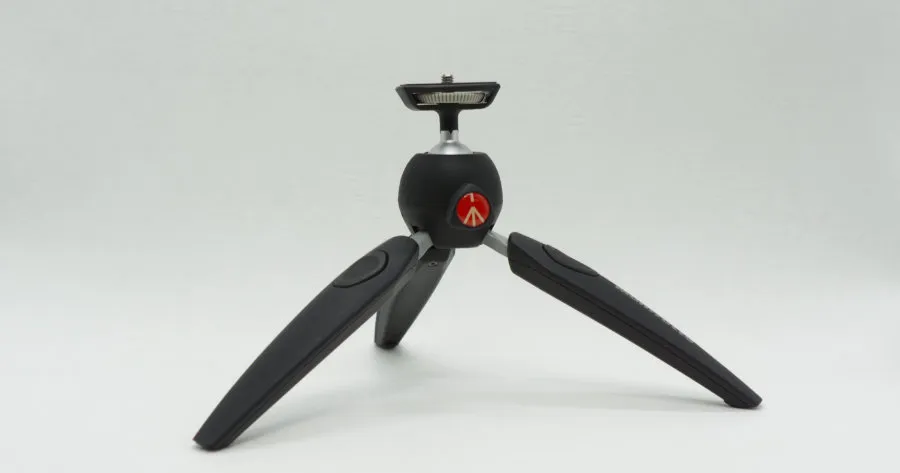
Short answer: matte-black legs with the red Manfrotto logo on the ball head — a familiar Manfrotto palette. The head and legs are one piece, and the head lock is the unusual “turn the logo on top” mechanism.
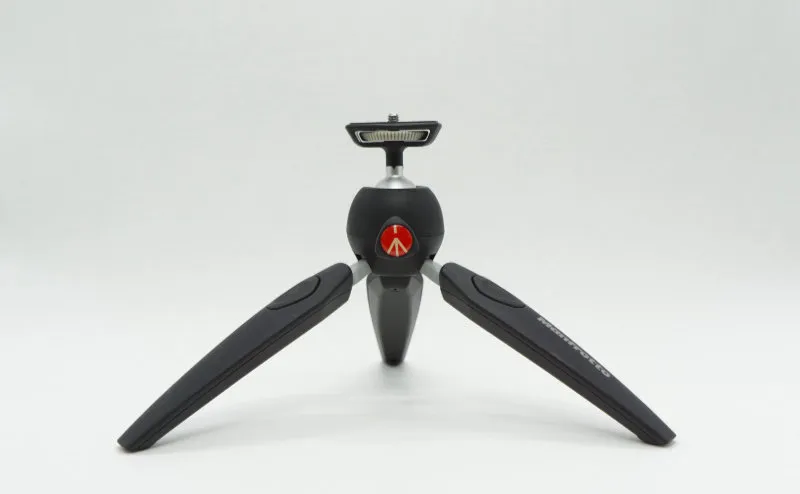
Categorically it is a 1/4-inch ball-head mini tripod. The legs carry an angle-mode switch at the base and a push-button telescoping lock on each leg. The silhouette is distinctive enough to stick in memory.
| Item | Value |
|---|---|
| Own weight | About 270g (rated) |
| Maximum load | About 2.5 kg (rated) |
| Head | Ball head (1/4-inch screw top plate) |
| Leg sections | 4 |
| Leg-angle modes | 2 (normal / low) |
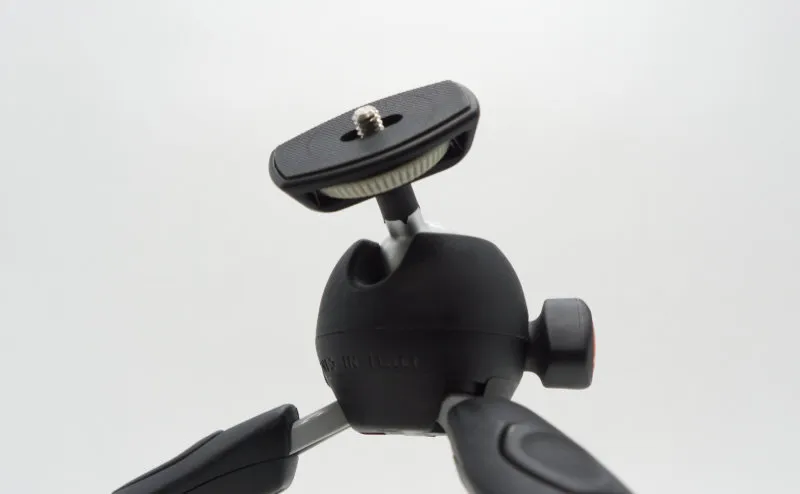
You lock the head by turning the red Manfrotto logo on the front. It is firm enough that it does not slip on its own. The 1/4-inch screw tightens via the dial on the head. An Arca-Swiss compatible clamp will screw on, but it is close to twice the head’s width, so the rig leans top-heavy.
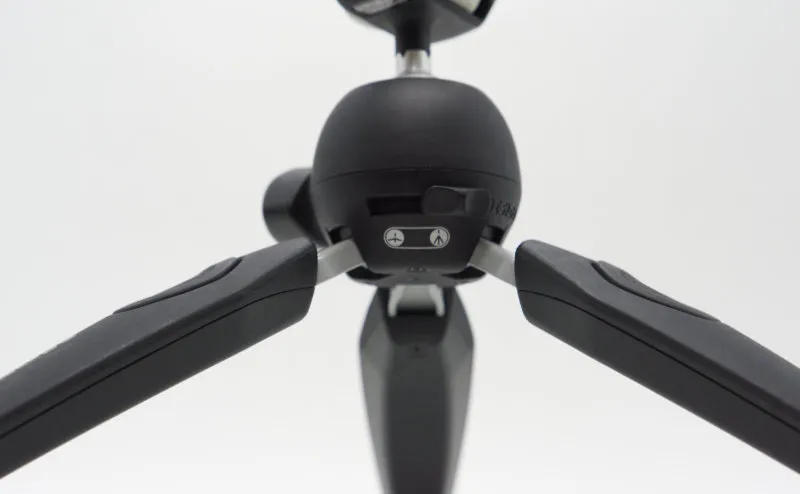
A slide switch at the base of the legs flips between normal and low leg-angle modes. The two modes are printed under the switch, so first-time use is unambiguous.
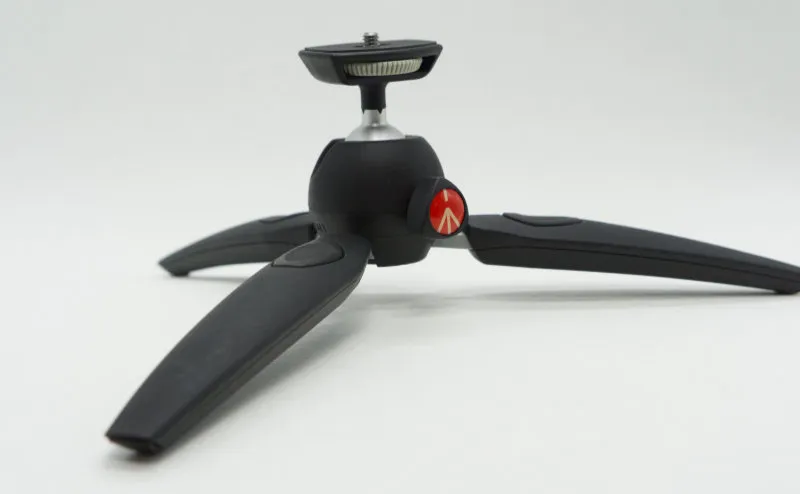
In low mode the legs splay almost flat to the surface. Useful when you are shooting product photos on a desk and want the camera right at subject height.
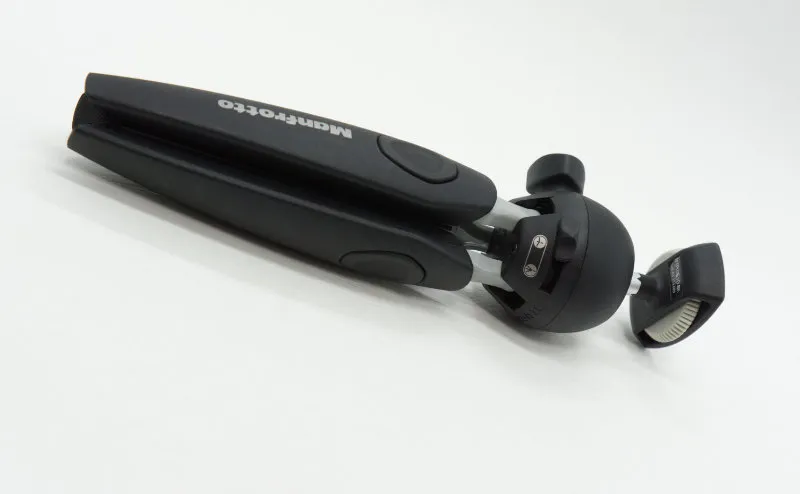
Folded, it is a slim cylinder. The backs of the three legs are cut at an angle so they sit flush against each other when closed. The result fits into a gap in a camera bag or the side pocket of a jacket.
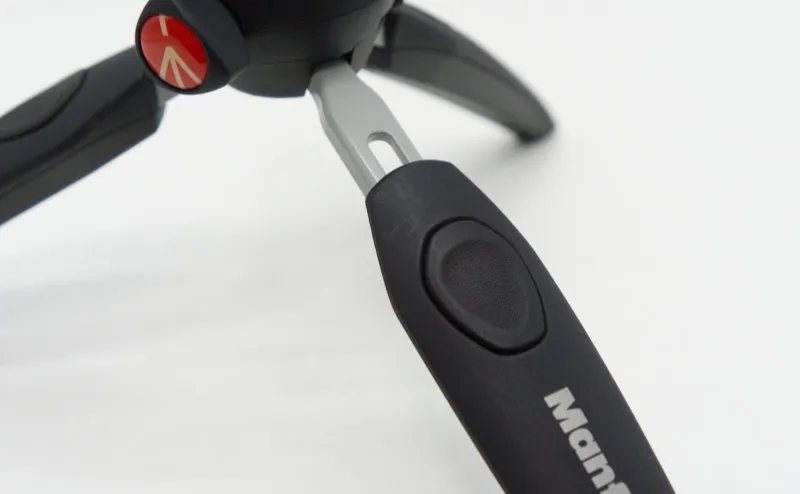
Each leg has a push-button telescoping lock. Press, pull, release — that is the whole interaction.
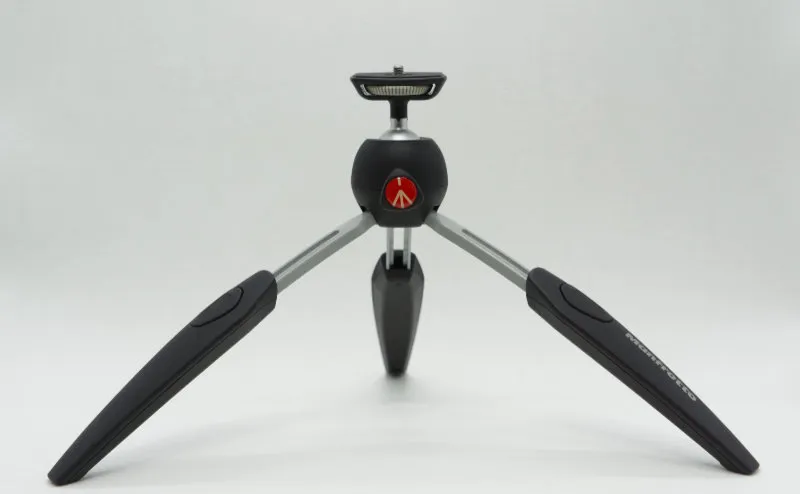
The legs telescope in four sections. They lock at intermediate stops too, but in practice almost every shoot ends up using either fully extended or fully retracted. Treat the in-between stops as fine adjustment and the design reads more cleanly.
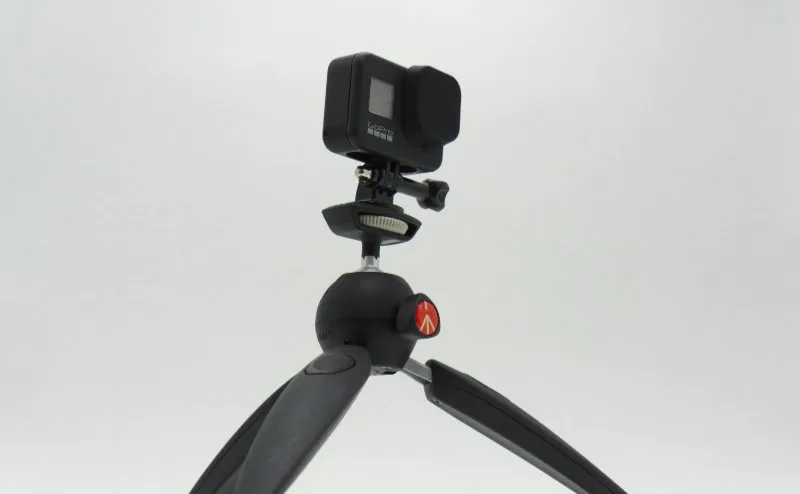
The camera body was in use for these review shots, so a GoPro stands in. For a GoPro-class load the PIXI EVO is wildly overspec’d, but the stability feels reassuring all the same.
What worked
Short answer: it stays rigid with a full-frame body on top; the two leg-angle modes plus four-section legs give it a real working height range; folded, it collapses into a slim stick that goes in a bag.
A 2.5 kg load rating — full-frame bodies are realistic
Unusually for a mini tripod, the head does not give up under a full-frame body with a standard zoom. A pro-grade telephoto zoom puts the centre of gravity too high to recommend, but anything up to a standard zoom is fine for desk product shots, table photography, and low-position street snaps.
The leg tips are rubber and grip on flooring and desk tops well. On gravel or concrete steps outdoors you have to adjust the leg angle so they bite, but that is a mini-tripod constraint in general, not a PIXI EVO one.
Two leg-angle modes plus four-section legs — real working height range
A typical mini tripod has fixed-length legs, which means it has exactly one usable height: “sitting on a desk.” The PIXI EVO sits flat on the floor in low mode, and reaches just below eye level in normal mode with the legs fully extended.
On a desk, low mode puts the camera at subject height for product shots. Outdoors, normal mode plus fully extended legs hits hip height for snap shots. Switching between scenes is fast. If you only want to carry one mini tripod across two or three shooting contexts, that flexibility earns its keep.
Folds into a stick — fits in the gaps in a bag
The angled cuts on the back of each leg mean the closed unit becomes a slim cylinder. It slides into the divider gap in a camera bag, or into the side pocket of a daypack. As “carryable in spite of being built for full-frame bodies” goes, it lands in the realm of “heavy but you will still bring it.”
Doubles as a selfie stick
With the legs folded, you can hold the column as a handle and get a passable selfie stick. Extending the legs while keeping them closed buys another few dozen centimetres. It will not match a dedicated selfie stick for length or weight, but on a trip the fact that you do not have to pack both a tripod and a selfie stick adds up.
What didn’t
Short answer: 270g is heavy for the class; the stiff ball-head lock makes 1° tweaks awkward; the bare 1/4-inch screw on top is exposed.
270g own weight — you notice it in the pouch
This is the flip side of “rigid enough for a full-frame body.” For a mini tripod it is on the heavy end. Drop it into a sacoche or a small pouch and you get a “do I really need to bring this today?” moment before heading out.
If portability is the deciding factor, a sub-60g flexible-leg option like the JOBY GorillaPod JB01542-PKK is the lighter answer. Load capacity and rigidity are separate concerns, though — the choice is “lighter, or higher load.”
Stiff ball-head lock, awkward at fine adjustments
The red logo plate that doubles as the head lock is firm. From a “do not let the camera fall” angle that is the right design choice, but when you are tightening a composition by one degree at a time, loosening the lock often shifts the framing more than you intended.
For video work where you want strict horizon levelling, or panning at a controlled speed, a three-way head or a dedicated ball head with independent lock pressure is the better tool. For stills, it is rarely a problem.
The bare 1/4-inch screw on top
There is no quick-release plate — the 1/4-inch screw sits exposed on the head’s top plate. Take the camera off and toss the tripod into a bag, and the screw rubs against the bag’s inner lining. A fabric inner case is enough to dodge the issue, but it is a design quirk.
Comparison
Short answer: heavier than a flexible-leg tripod but more rigid; heavier and pricier than the plain PIXI but with more load capacity and height range; less tall than a typical telescoping mini tripod, but more compact head-and-all.
vs JOBY GorillaPod JB01542-PKK — “light and unusual placements” vs “rigid and high load”
| Angle | Manfrotto PIXI EVO | JOBY GorillaPod JB01542-PKK |
|---|---|---|
| Intended gear | Phone to full-frame standard zoom | Phone, webcam, GoPro |
| Own weight | About 270g (rated) | About 52g (rated) |
| Maximum load | About 2.5 kg (rated) | About 325g (rated) |
| Mounting site | Flat floor or desk | Floor, pillar, handrail, shelf edge |
| Height adjustment | 2 leg angles + 4-section legs | Bend the legs as needed |
| Ball-head lock | Yes (firm) | Yes (firm, stepless) |
The PIXI EVO is for planting heavy gear on a flat surface. The GorillaPod is for hooking light gear onto a non-flat one. The use cases are opposite, so the decision is “do I want to carry weight, or to place it in odd spots.” For a full comparison, see the JOBY GorillaPod JB01542-PKK review.
vs the plain PIXI — “lighter and cheaper” vs “more load and more height”
| Angle | PIXI EVO | Plain PIXI |
|---|---|---|
| Intended gear | Up to full-frame standard zoom | Up to mirrorless standard zoom |
| Maximum load | About 2.5 kg (rated) | About 1 kg (rated) |
| Leg sections | 4 | None (fixed length) |
| Leg-angle modes | 2 | 1 |
| Price tier | Mid | Entry |
If a phone, a compact, or a mirrorless body with a kit zoom is the full scope of use, the plain PIXI is enough. If “I might bring a full-frame body one day” or “I want to switch between low and high” is part of the plan, the EVO’s price premium is meaningful.
vs a typical telescoping mini tripod
| Angle | PIXI EVO | Typical telescoping mini tripod |
|---|---|---|
| Maximum height | 4-section legs + normal angle | Centre column reaches higher |
| Head | Integrated ball head | Sometimes three-way heads |
| Fine adjustment | Weak (lock is firm) | Three-way heads handle this well |
| Folded form | Legs flush, slim cylinder | Head tends to protrude |
| Portability | Fits gaps in a bag | Depends on size |
If “slim when folded” and “switch between desk-low and just-below-eye-level” matter, the PIXI EVO wins. If “tallest possible” and “smooth video adjustment” matter, you are looking at a different category. Same “mini tripod” label, different target situations.
FAQ
Q. Should I pick the plain PIXI or the PIXI EVO? A. Decide by the gear you plan to mount. For a phone, a compact, or a mirrorless body with a kit zoom, the plain PIXI is enough. If a full-frame body with a standard-to-short-telephoto zoom is in scope, the PIXI EVO’s 2.5 kg rating and four-section legs are the safer choice. Conversely, if you only ever sit it on a desk to shoot phone vlogs, the EVO’s extra weight and bulk are overkill.
Q. Can it double as a selfie stick for a GoPro or a phone? A. With the legs closed, you can grip the column as a handle and treat it as a makeshift selfie stick. Extending the legs while keeping them closed buys another few dozen centimetres of reach. It will not match a dedicated selfie stick for length or weight, so think of it as a tripod that occasionally pulls double duty.
Q. Will it carry an Arca-Swiss compatible clamp? A. The head’s top plate is a 1/4-inch screw, so a standard Arca-Swiss clamp screws on directly. The clamp is usually close to twice the width of the head itself, so the rig ends up top-heavy. If Arca-Swiss is your default, picking the smallest clamp you can live with is steadier than swapping the head outright.
Q. Can I use it outdoors with a full-frame DSLR or mirrorless? A. Within the stated 2.5 kg load it carries fine, but ground and wind matter. On gravel or concrete steps, adjust the leg angle so the rubber feet bite. For long exposures, keep the centre of gravity low — no centre-column extension, no strap wrapped around the body. On windy days, hang a bag under the tripod as ballast.
Verdict — a strong pick if you want exactly one mini tripod
The PIXI EVO is one of the few mini tripods that simultaneously delivers load capacity, rigidity, a working height range, and a slim folded form. It is heavier than phone-only ultralights, and it cannot wrap legs around a pillar like a flexible-leg tripod, but it does make the realistic case — “carry one tripod that handles full-frame bodies indoors and outdoors” — actually work.
In more than two years of daily-ish use, neither the head lock nor the telescoping locks have loosened with age. For someone who would rather carry a little more weight in exchange for a tripod that lasts, it is the right tool.
If “as light as possible” or “wrap it around a pillar” is the real requirement, a different category will be a happier purchase. If the use case is “plant slightly heavy gear on a flat surface,” this is a hard one to regret.