
Contents13
- The verdict — for anyone who wants a desk mug that doesn’t tip
- Build and feel
- What worked
- Wide base, hard to tip
- A lid that keeps dust out
- Light, with a roomy handle
- What didn’t
- Refill noodles cost more than a regular Cup Noodle
- Some smell carries over
- The look is hard to bring out at work
- Comparison — versus other desk mugs
- FAQ
- Verdict — bought as a novelty, kept as a tool
2026 update: Ported from the old VuePress blog. The refill mug itself is still listed on Nissin’s official online shop and at the Cup Noodles Museum shop. The numbers are the manufacturer’s published figures from the original writing; current official specs may differ. Heavily rewritten.
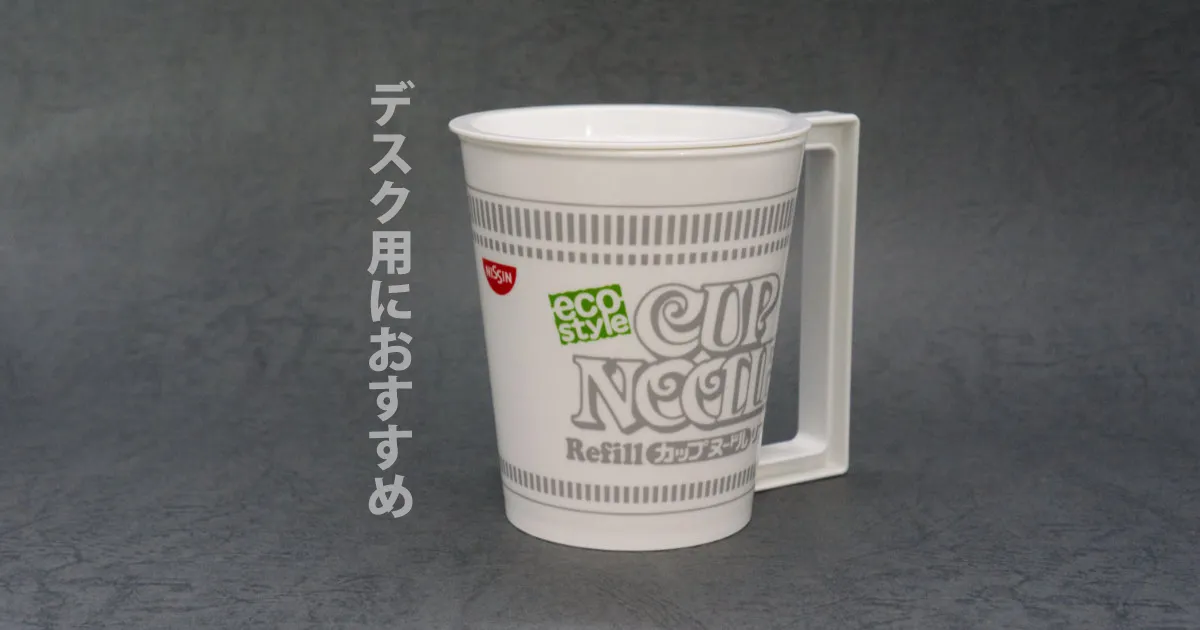
I picked up the “Refill Lidded Mug” on the way home from the Cup Noodles Museum, mostly as a novelty. It was designed for swapping in refill noodles, but it ended up living on my desk as a daily-use cup.
It feels better suited to that — a desk mug for coffee or tea — than to its stated purpose. The reasoning is below.
The verdict — for anyone who wants a desk mug that doesn’t tip
Short answer: the wide base and low center of gravity make it hard to knock over, even sitting right next to a keyboard. The lid keeps dust out and the polypropylene body is light. If you can live with the look, the practical value is high for the price (under 1,000 yen).
Three reasons:
- The base is wider than a typical mug: the shape is a direct copy of the Cup Noodle cup, so it absorbs a stray arm or sleeve without going over
- A lid is included: it comes with a vented lid, so dust doesn’t get in while it sits on your desk
- Light in the hand: polypropylene is much lighter than ceramic, which makes carrying it around easier
It is harder to recommend if any of these apply:
- You don’t want a loud design on your desk: it is the Cup Noodle livery, untouched — not always a great fit for a workplace or a customer meeting
- You want cold drinks with condensation handled: as a plastic mug it insulates worse than ceramic
Build and feel
Short answer: a Cup Noodle cup with a handle bolted on. The material is polypropylene, and because it was designed to hold refill noodles, the base is wide.
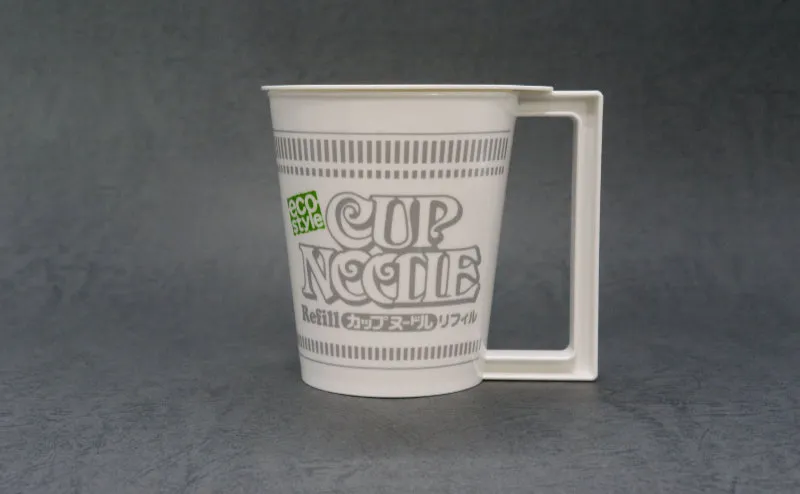
The front is the Cup Noodle packaging, as-is. To someone who doesn’t know the product, it looks like you are drinking Cup Noodle.
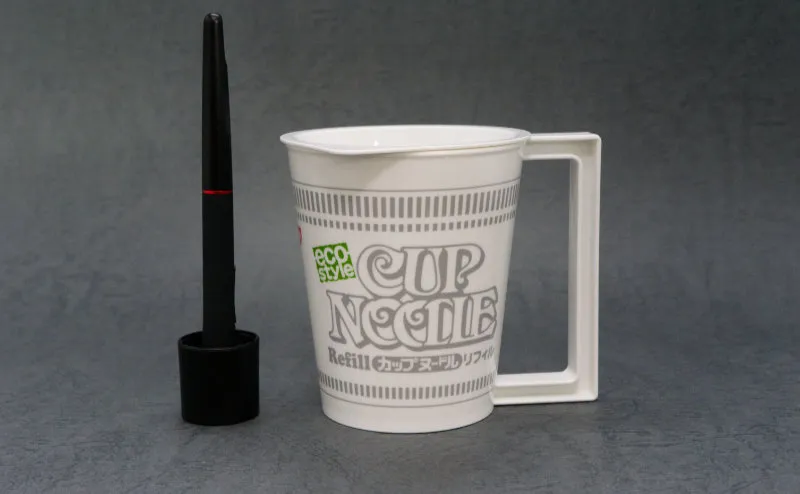
The width and height are roughly the same as a regular-size Cup Noodle (rated). As a mug it reads as a little wider and a little shorter than usual.
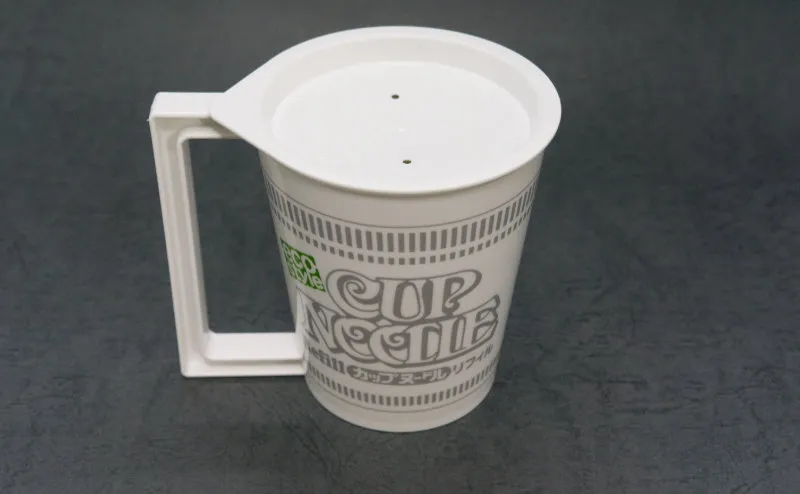
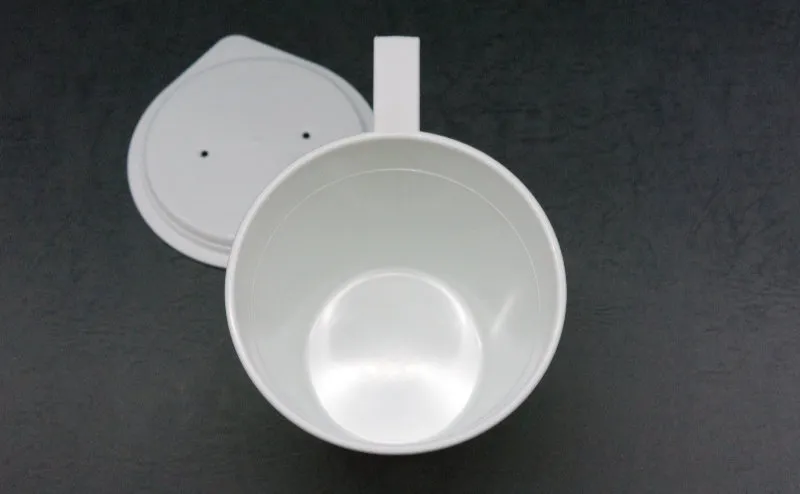
Inside is the molded fill-line rib for hot water. The base has a wide outer diameter and a large footprint. Most mugs taper from a wide rim to a narrower bottom; this one is closer to the opposite.
The material is polypropylene. Heat resistance is listed as 140 degrees C.
What worked
Short answer: stability from the wide base, dust protection from the lid, and how light it is.
Wide base, hard to tip
This is the headline difference. I had spent years occasionally knocking over the mug on my desk with a stray arm or sleeve; in the six-plus months since switching to this one, I have not tipped it once.
The reason is built in. A Cup Noodle cup is designed to stay upright on an unstable surface — low center of gravity, wide base.
A lid that keeps dust out
It comes with a vented lid as standard. There is no locking mechanism, so it is not the cup for commuting with, but for something that stays parked on a desk it is enough.
Knowing that dust and crumbs aren’t drifting into the cup while I am away from my seat changes how the cup feels day to day.
Light, with a roomy handle
Polypropylene is noticeably lighter than ceramic. The handle is large enough for three fingers, which makes it easy to carry full.
It is also labeled as microwave-safe, so reheating a cold coffee can happen in place.
What didn’t
Short answer: the refill noodles cost more than a regular Cup Noodle, the plastic picks up some smell, and the look isn’t always workplace-safe.
Refill noodles cost more than a regular Cup Noodle
The intended workflow — drop refill noodles into the mug, pour hot water — doesn’t really pencil out. A regular-size Cup Noodle is often cheaper.
Given the production scale, the refill premium is understandable, but if you bought the mug specifically for that use, it is a small letdown.
Some smell carries over
Polypropylene picks up a small amount of color and smell after coffee or tea, even after washing. It is something you notice when you compare against a ceramic mug, not something that gets in the way of daily use.
The look is hard to bring out at work
The packaging is unchanged, so it doesn’t sit naturally in a customer meeting or a more formal office. For a desk you sit at alone it is fine; for shared spaces a plain mug is the safer pick.
Comparison — versus other desk mugs
Short answer: a mug that is both hard to tip and has a lid, for under 1,000 yen, doesn’t have many direct competitors.
| Angle | Cup Noodle Refill Lidded Mug | Typical ceramic mug | Thermos-style tumbler (with lid) |
|---|---|---|---|
| Tip resistance | Wide base, hard to tip | Roughly the same diameter top-to-bottom, easier to tip | Depends on base; narrow ones tip easily |
| Lid | Included (vented, no lock) | Sold separately | Included (some lockable) |
| Weight | Light (plastic) | Heavy | Medium (metal) |
| Insulation | Weak (single-wall plastic) | Medium | Strong (vacuum-insulated) |
| Microwave | Yes (rated) | Depends on the piece | No (metal) |
| Visual restraint | Loud | Usually neutral | Neutral |
| Price | Under 1,000 yen | A few hundred to a few thousand yen | 2,000 yen and up |
If you want full insulation, a Thermos-style tumbler is the right tool. If you want a neutral look and microwave compatibility, a regular ceramic mug. If the requirement is “won’t tip, has a lid, cheap,” this one fits.
FAQ
Q. Is it dishwasher-safe? A. Depending on the package, it may be listed as not supported. As a plastic mug, repeated hot-cycle dishwashing risks deformation, and hand-washing is the safer call.
Q. Where can I buy it? A. The Nissin Foods online shop, the museum shop at the Cup Noodles Museum, and various marketplaces. Physical retail is limited, so online is the realistic route.
Q. How much does it hold? A. Roughly the same capacity as a regular-size Cup Noodle. As an everyday drink cup it reads on the larger side.
Q. Can kids use it? A. It is light and won’t shatter, so it is friendlier than ceramic in that sense. The lid does not lock, though, so for actual spill-proofing a kids’ mug with a locking lid is safer.
Verdict — bought as a novelty, kept as a tool
Short answer: the intended use (refill noodles) is hard to justify on cost, but as a lidded desk mug it earns its place for the price.
I bought it as a Cup Noodles Museum souvenir, and six-plus months later it is still on my desk every day. That was not the plan.
If the brief is “a lidded mug that won’t tip, under 1,000 yen,” competitors are thin on the ground. Whether it works for you depends on how much you can live with the look.
I am quietly considering buying a second one for the office.