
Contents16
- The verdict — a good match for anyone wanting to fix a webcam to a pillar or handrail
- The look — all plastic with rubber leg tips, a 50-something gram mini tripod
- What worked
- Wide leg range — wraps around pillars, handrails, and shelves
- Light — no guilt about leaving it hanging at face height for hours
- Magnetic leg tips for casual mounting on steel shelving or cabinets
- No quick release is actually a plus if all your gear uses 1/4-inch screws
- What didn’t
- A mirrorless puts the centre of gravity too high
- The ball head is stiff and bad at 1° adjustments
- No quick release is a minus for anyone swapping gear often
- Comparison
- vs a typical extendable tripod
- vs other flexible tripods (inside the GorillaPod line)
- FAQ
- Verdict — a specialist for “light gear in awkward places”
2026 update: Ported from the old VuePress blog. The JOBY GorillaPod JB01542-PKK is still in circulation as part of the current line-up in 2026, but successors and variants (GorillaPod Mobile / Magnetic / 1K, etc.) have multiplied. Read this as a review of one specific use case — fixing a webcam in place — rather than as a universal recommendation.
When remote work started, I wanted to wrap a webcam around the pillar next to my desk and fix it slightly above eye level. The generic tripods I had on hand could only extend their legs — none of them could “wrap around a pillar” — so I ended up buying a JOBY GorillaPod to add to the kit.
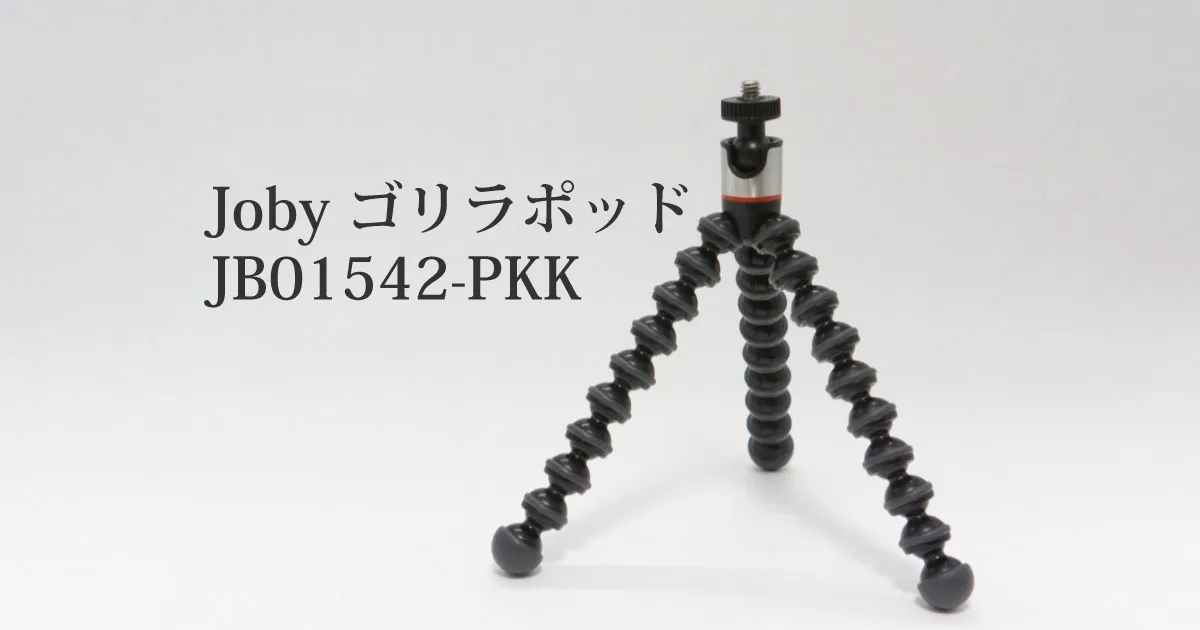
What I bought was the JOBY GorillaPod JB01542-PKK (ball head with 1/4-inch screw, mini-size flexible-leg type). After about half a year of leaving it permanently set up for webcam duty, here is the write-up.
The verdict — a good match for anyone wanting to fix a webcam to a pillar or handrail
Short answer: with its three wide-articulating legs, wrapping it around a pillar to fix a webcam above eye level is something it does honestly well. As a tripod for heavier gear like a mirrorless, though, the 50-something gram body is far too light, and the ball head does not take kindly to fine adjustment. Treat it as a specialist for “light gear, awkward places” and the satisfaction is high.
Good fit:
- You want to wrap a webcam or phone around a pillar, handrail, or shelf for work-from-home use
- You want to travel with just one tripod (for phone or GoPro use)
- You want to mount unusually — on a monitor edge or a desk leg
Less of a fit:
- You want to put a mirrorless plus standard zoom (or heavier) on it — both the load rating and the tripod’s own weight are short
- You want a ball head that adjusts in 1° steps
- You want a quick release for swapping cameras often
The look — all plastic with rubber leg tips, a 50-something gram mini tripod
Short answer: the body is moulded plastic, the joints in the legs are ball-shaped and rotate 360°, and the leg tips have anti-slip rubber and a small magnet. It sits in the palm of one hand, and paired with a webcam the balance comes out right.
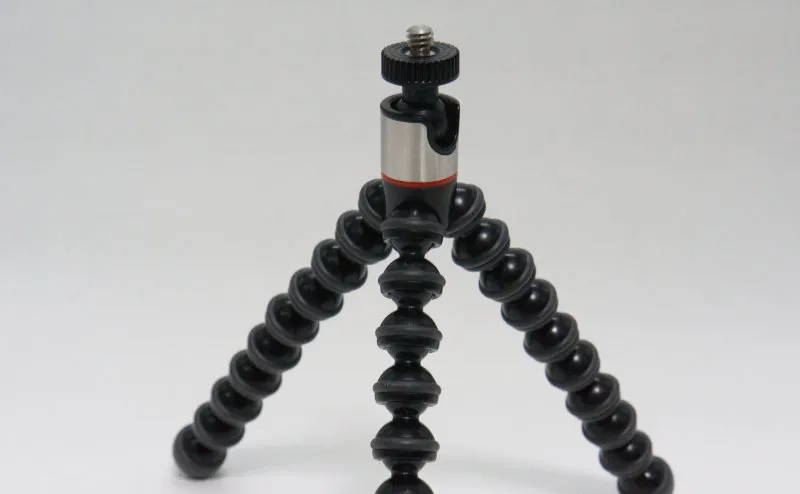
By category this is a mini tripod with a 1/4-inch screw and ball head. The leg joints are chains of ball segments that each rotate independently, so the legs as a whole bend freely.
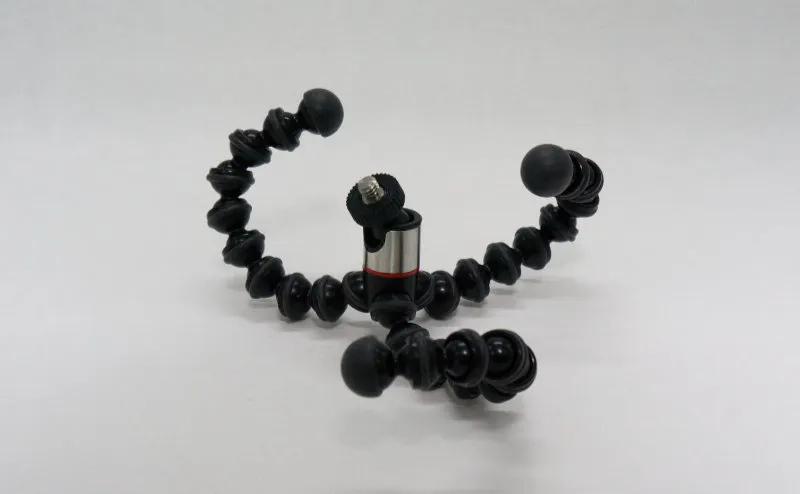
The range of motion is enough that, for a handrail-thickness pole (around 4cm diameter), three legs can wrap around it without strain. The head tilts to roughly 90°, so horizontal shooting is also workable.
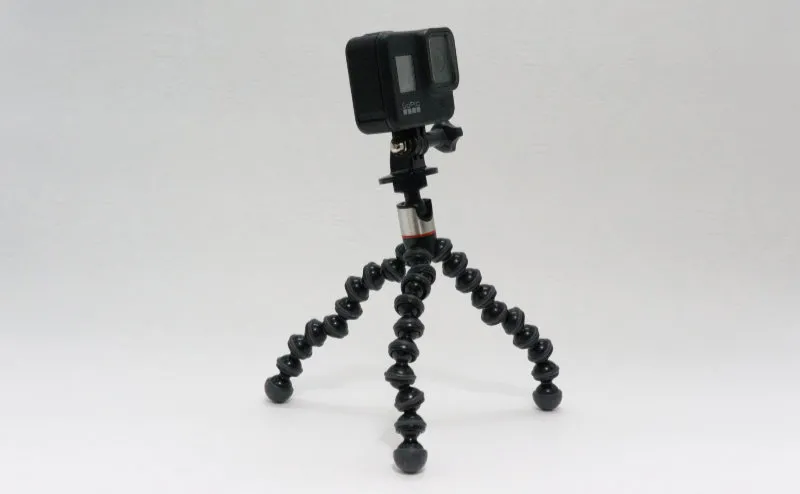
This is roughly the size with a GoPro mounted. Own weight is around 52g, maximum load around 325g. With a mirrorless the centre of gravity ends up too high and balance is easily lost, but it pairs cleanly with a phone, a GoPro, a compact, or a webcam.
What worked
Short answer: the flexibility of where you can place it — “wrap around a pillar”, “clamp onto a monitor edge”, “tangle around a desk leg” — is the biggest difference from an ordinary tripod.
Wide leg range — wraps around pillars, handrails, and shelves
A normal tripod assumes you will set it on the floor. With the JB01542-PKK, each of the three legs bends freely, so wrapping around a cylindrical object to fix the camera in place is genuinely workable. For my permanent home-office setup, wrapping it around the pillar by the desk and placing the webcam slightly above face level worked on the first try.
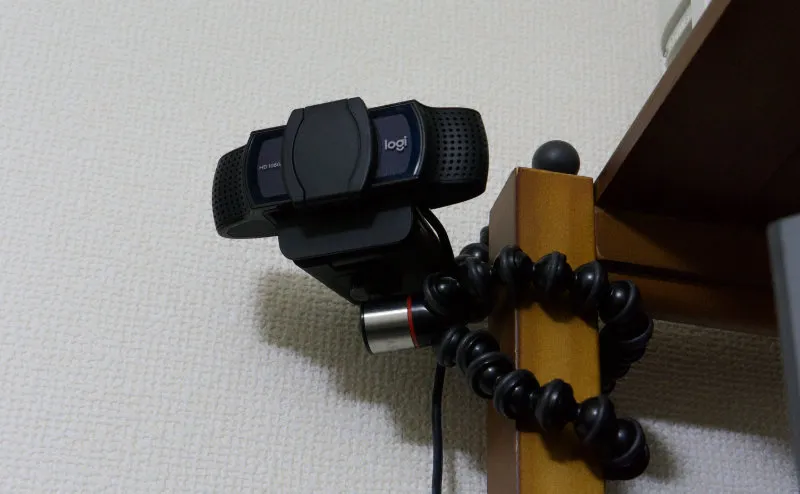
The actual fixed setup. One leg is hooked over the top of the pillar, and the other two are wrapped around it. Wrapping all three works too, but hooking one leg upward stops it from sliding down.
Light — no guilt about leaving it hanging at face height for hours
Around 50g for the tripod itself. Combined with a webcam (about 100g) the total still falls short of 200g. In a setup where the thing is dangling at head height for long stretches, weight translates directly into drop risk, so the lightness itself is reassuring. It did not shift in shaking up to JMA seismic intensity 3 (within my own trial range).
Magnetic leg tips for casual mounting on steel shelving or cabinets
Each leg tip has a small magnet inside. It will cling lightly to steel shelving or a cabinet top when set down — useful for casual mounting in places you cannot wrap around. It is not strong enough on its own to hold a camera, so treat it strictly as an aid.
No quick release is actually a plus if all your gear uses 1/4-inch screws
If everything on your camera side — webcam, GoPro mount, compact — already takes a 1/4-inch screw, a quick release is just one more adapter to thread through. The JB01542-PKK screws on directly, so no conversion plate is needed.
What didn’t
Short answer: it is too light, so a mirrorless puts the centre of gravity too high. The ball head is stiff and bad at fine adjustment. There is no quick release, so frequent swapping is awkward.
A mirrorless puts the centre of gravity too high
The 325g load rating is high enough on paper that some entry-level mirrorless bodies clear it. In practice the higher the centre of gravity, the easier it tips. With a mirrorless and a standard zoom on top, it slowly leaned over — not by the head lock giving up, but by the leg joints flexing. Safer to treat it as out of spec, and reach for a larger tripod for anything mirrorless-class and up.
The ball head is stiff and bad at 1° adjustments
The head’s angle lock has no adjustment screw — it is a press-fit held by firm resistance from the start. That is good for preventing drops, but for composing in fine steps you can really only move it in 5°–10° increments. Not the right pick for anyone who needs to nail a horizontal in video.
No quick release is a minus for anyone swapping gear often
The flip side of the “1/4-inch direct” advantage. If you cycle through multiple bodies, every swap means turning a screw. For a permanent install, it is a non-issue.
Comparison
Short answer: against a “tripod you put on the floor”, placement freedom wins by a wide margin. Against “other flexible tripods”, it is cheaper but loses to higher models (GorillaPod 1K / 3K and so on) on load rating and rigidity.
vs a typical extendable tripod
| Angle | JB01542-PKK | Typical extendable mini tripod |
|---|---|---|
| Placement | Floor, pillar, handrail, shelf edge | Flat floor only |
| Height adjustment | By bending the legs | Stepped, via the elevator column |
| Own weight | ~52g (rated) | ~200–500g |
| Load rating | ~325g (rated) | 1–3kg class is common |
| Fine adjustment | Weak (ball head is stiff) | Strong on 3-way head models |
| Price band | Cheap | Cheap to high-end, full range |
Extendable tripods are good at placing heavy gear on a flat floor. The JB01542-PKK is good at hooking light gear onto non-flat places. The use cases are different, so the choice comes down to “where do you want to put it?“.
vs other flexible tripods (inside the GorillaPod line)
| Angle | JB01542-PKK | GorillaPod 1K Kit | GorillaPod 3K Kit |
|---|---|---|---|
| Target gear | Phone / webcam / GoPro | Mirrorless (light) | Medium DSLR |
| Load rating | ~325g | ~1kg | ~3kg |
| Head | Simple ball | Ball + pan | Ball + pan + Arca-Swiss compatible |
| Quick release | No | Yes | Yes |
| Size | Mini (palm-sized) | Medium | Large |
| Price band | Cheapest | Mid | High |
Inside the GorillaPod line, the JB01542-PKK sits as the smallest, lightest, cheapest entry-level option. If you are planning around a mirrorless or up, 1K and above is the safer band. Conversely, if you will only ever mount a webcam and a phone, the weight and price of the 1K is overspec.
FAQ
Q. Is it okay to mount a mirrorless camera on it? A. The manufacturer’s stated maximum load is around 325g. An entry-level mirrorless body on its own just about clears that, but adding a lens usually pushes it over. In practice it is safer to stick to gear under 300g — phones, compacts, webcams, GoPros.
Q. Will cameras other than 1/4-inch screw fit? A. The head is 1/4-inch screw only. There is no quick release. You can add a separate Arca-Swiss clamp meant for a DSLR and effectively share gear across tripods, but the added weight cancels out the lightness advantage.
Q. How strong is the magnet in the legs? A. Each leg tip has a small magnet that lightly clings to steel surfaces like shelving or cabinet tops. It is not strong enough on its own to hold a camera in place — it is meant as an aid to wrapping or to spreading the legs (JOBY does not publish a specific holding force).
Q. Is it suited to outdoor or travel use? A. At around 50g it is light and packs into a gap in a bag, so portability is high. On the other hand it is weak in wind, so for long exposures or time-lapses outdoors it is safer to weigh it down with a stone or a bag, or to bring a full-size tripod as well.
Verdict — a specialist for “light gear in awkward places”
As a general-purpose tripod it is underpowered, but for someone who wants to do something unusual — like wrapping a webcam around a pillar — there is really no other option. That kind of product.
Over half a year of permanent use, the webcam + JB01542-PKK pairing ran without trouble. It did not slip down through a JMA seismic intensity 3 quake, and the ball head’s lock did not loosen.
Conversely, if you want to mount a mirrorless, dial in fine adjustments, or swap cameras often, a higher-end GorillaPod 1K Kit or a straightforward extendable tripod will leave you happier. A tripod that is strong when the use case is narrow, weak when it is not.