Contents17
- Check the monitor’s inputs and built-in KVM first
- Quick table by situation
- Two or more inputs: direct cables and a USB switch
- Monitors with a built-in KVM
- One input: a separate KVM
- Picks by situation
- Two or more inputs, sharing only a keyboard and mouse
- Both computers output HDMI, one button for everything
- Both computers output video over USB-C, one button for everything
- A USB-C monitor input and both computers outputting video over USB-C
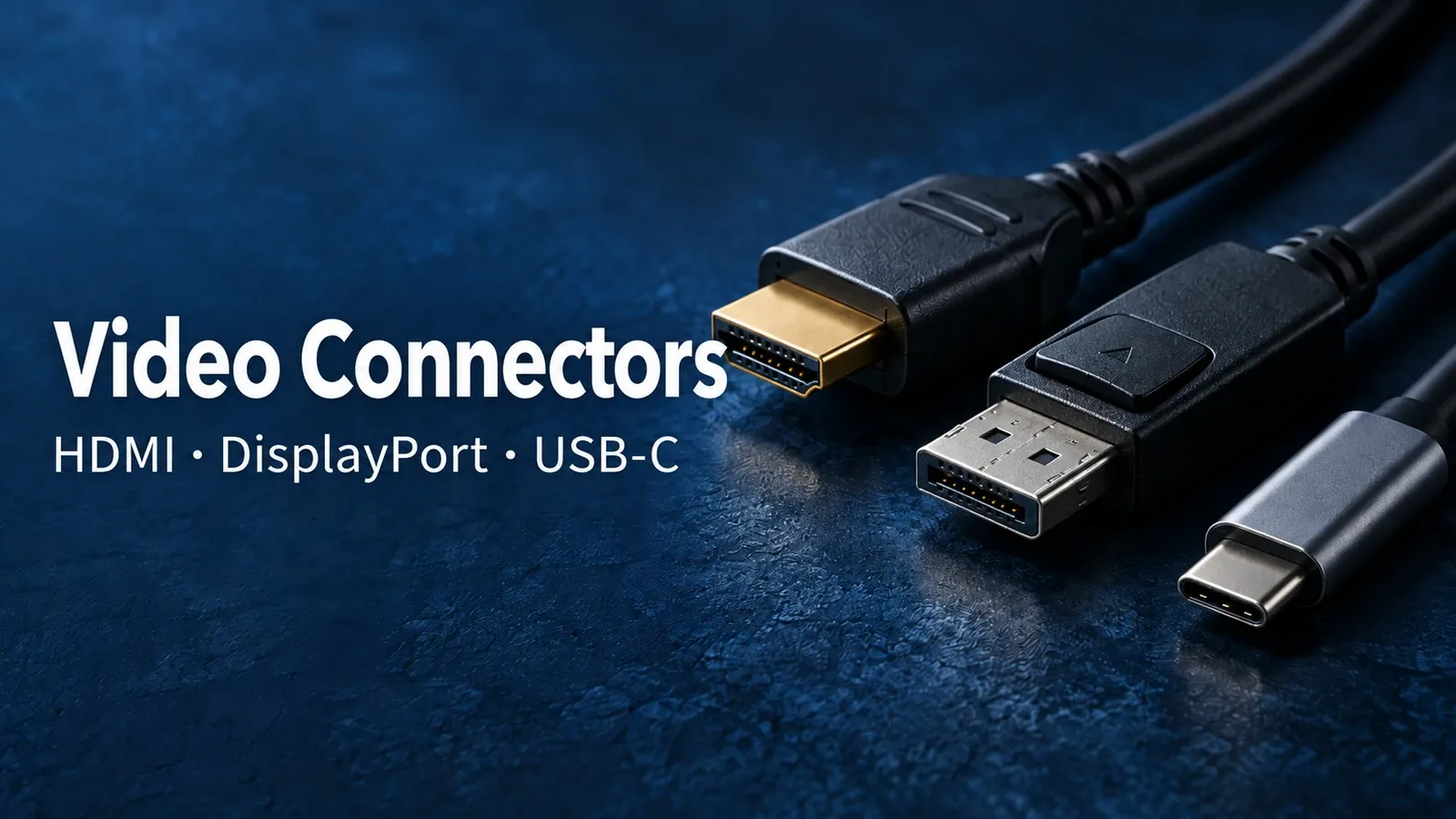
- What each video port can output
- FAQ
- If my monitor has two inputs, do I still need a KVM?
- Is a monitor with a built-in KVM cheaper than a separate KVM?
- Why does the screen layout change after each switch?
- Can I switch computers with the laptop lid closed?
- Can one monitor show both computers at the same time?
First check how many inputs your monitor has and whether it has a built-in KVM (a keyboard, video and mouse switch). If it has 2 or more inputs that match both computers’ video ports, plug each computer in directly and switch only the keyboard and mouse with a USB switch. With one input, or if you want one button for everything, use a separate KVM.
Sources are manufacturer spec pages, manuals and video standards as of October 2026; bandwidth is worked out from each standard’s formula. Nothing was tested. Hz is how many times per second the screen redraws.
Check the monitor’s inputs and built-in KVM first
On the spec sheets, check the monitor’s inputs (HDMI, DisplayPort, USB-C), any built-in KVM, and each computer’s video port.
USB-C ports look alike but some carry no video. Video comes from ports that support DP Alt Mode (DisplayPort signals over USB-C); Dell points to a DisplayPort or lightning-bolt mark by the port.
A KVM switches the monitor’s picture as well as the keyboard and mouse. A USB switch moves only USB devices, not the picture.
Quick table by situation
Verdicts are this article’s summary. The 2+ input rows mean switching with two presses (the monitor’s input button and the switch) and assume the inputs match both computers’ video ports. Yes means it works; Check first means confirm before buying.
| Monitor and ports | Setup | Verdict | Check first |
|---|---|---|---|
| 2+ inputs; same kind of video port on both | Direct cables + USB switch | Yes | The number and type of monitor inputs, and the USB plug on each computer |
| 2+ inputs; USB-C laptop, HDMI or DisplayPort desktop | Direct cables + USB switch (may need an adapter) | Check first | Whether the monitor has inputs matching both ports (or an adapter cable) |
| The monitor itself has a built-in KVM | May not need a separate one | Check first | Which video input pairs with which USB upstream port |
| One input or one button; both HDMI | HDMI KVM | Yes | An HDMI input on the monitor (the KVM picks output HDMI), the KVM’s stated resolution and Hz, and the USB plug on the computer side |
| One input or one button; both video over USB-C | USB-C KVM | Yes | Both USB-C ports support video (DP Alt Mode), and the monitor has an HDMI input |
| One input or one button; laptop video over USB-C only, HDMI or DisplayPort desktop | HDMI KVM + adapters | Check first | Check which USB connection the KVM needs on each computer (the spec lists HDMI + USB); the spec page does not say adapters work |
| Unsure which port the laptop uses for video | Check first (the video output) | Check first | The laptop’s spec sheet (video ports) |
Pick your monitor’s inputs, how you want to switch and each computer’s video port to see the setup that fits.
Two or more inputs: direct cables and a USB switch
If the monitor has 2 or more inputs that match both computers’ video ports, you do not need a KVM. Plug the laptop and the desktop into separate inputs and switch only the keyboard and mouse with a USB switch. Switching takes two presses: the monitor’s input button and the USB switch.
If the laptop outputs video over USB-C and the monitor has a USB-C video input, plug it in directly. If not, use a USB-C to HDMI or USB-C to DisplayPort cable into a free input, and check it supports your resolution and refresh rate.
Monitors with a built-in KVM
A monitor with a built-in KVM may make a separate switch unnecessary. Each computer connects by a video cable plus a USB cable or one USB-C cable that carries both, and you switch in the monitor’s menu. BenQ says the Auto setting moves USB along with the input.
On some models a USB-C port carries data only, so check the manual for which video input pairs with which USB port.
One input: a separate KVM
With only one input, or to switch everything with one button, use a separate KVM. Choose an HDMI KVM if both computers output HDMI, or a USB-C KVM if both output video over USB-C.
Per the makers’ official spec pages as of October 2026, the USB-C KVM picks need USB-C ports with video (DP Alt Mode) on both computers. A desktop that outputs video only over HDMI or DisplayPort cannot connect.
No KVM that connects a USB-C laptop and an HDMI or DisplayPort desktop without adapters met the criteria among Amazon.com listings checked on October 28, 2026. The HDMI KVM pick connects to each computer with HDMI and USB cables, so it does not suit a laptop with only USB-C. Whether it works through adapters is not stated on its spec page and was not confirmed.
The KVM picks are all rated up to 4K at 60Hz, so Full HD and QHD at 60Hz should work. For a monitor at 144Hz or more, choose a KVM whose spec page states that refresh rate, or use direct cables. A USB-C monitor input can use the USB-C switch pick below, listed at 4K 144Hz on Windows.
Picks by situation
For direct cables the pick is a USB switch; if both output HDMI, an HDMI KVM; if both output video over USB-C, a USB-C KVM.
Two or more inputs, sharing only a keyboard and mouse
For direct cables, the UGREEN USB 2.0 Switch, 2 in 4 out (30767) is a USB switch with 4 USB 2.0 ports and no video. Its cables are USB-A on the computer side, so a USB-C-only computer cannot connect as is.
Sold by UGREEN GROUP LIMITED.
Both computers output HDMI, one button for everything
If both computers output HDMI, the TESmart HKS201-P23 is a 2-computer HDMI KVM rated up to 4K at 60Hz (4:4:4) with USB 3.0 sharing. The Amazon.com page says P23, not V2, and the V2 version is unconfirmed.
Sold by TESmart. It has only 68 ratings so far.
Both computers output video over USB-C, one button for everything
If both computers output video over USB-C, the Cable Matters 201478 switches them to one HDMI monitor at up to 4K 60Hz, and charges each at up to 85W when both are connected. Cable Matters notes some computers are limited to 30Hz on it.
Sold by Cable Matters. It has only 16 ratings so far.
A USB-C monitor input and both computers outputting video over USB-C
If the monitor has a USB-C input and both computers output video over USB-C, the Cable Matters USB-C Switch for 2 Computers (201352-B) shares it between them. It connects to the monitor’s USB-C input and has no HDMI or DisplayPort output. Cable Matters lists up to 4K at 144Hz on Windows and 4K at 60Hz on macOS, and pass-through charging up to 140W.
Each pick is the cheapest Amazon.com listing checked on October 28, 2026 that met its condition: 100+ ratings, 4+ stars, sold new by Amazon or the maker. Both KVM picks have under 100 ratings and are exceptions: sold new by the maker, model number matched, 4+ stars.
What each video port can output
By this bandwidth calculation (reduced blanking, 8-bit color, no compression), 4K at 60Hz fits DisplayPort 1.4, HDMI 2.0 and HDMI 2.1. It only just fits USB-C (DP 1.4) alongside USB 3.
1440p at 144Hz fits DisplayPort 1.4 and HDMI 2.1 and depends on the signal timing on HDMI 2.0. 4K at 120Hz fits HDMI 2.1 and depends on the signal timing on DisplayPort 1.4.
Verdicts are calculated with reduced blanking, 8-bit color, no compression and HDMI 2.1 at 48 Gbps; the formula and capacities are in the data section at the end. “Depends on the signal timing” means it changes with the video signal timing the monitor picks. The USB-C column is 2 lanes alongside USB 3 data; with all 4 lanes for video it matches the DisplayPort 1.4 column.
| Mode | USB-C (DP 1.4, with USB 3) | DisplayPort 1.4 | HDMI 2.0 | HDMI 2.1 (48 Gbps) |
|---|---|---|---|---|
| 1080p 60Hz | Fits | Fits | Fits | Fits |
| 1440p 60Hz | Fits | Fits | Fits | Fits |
| 4K 60Hz | Only just | Fits | Fits | Fits |
| 1440p 144Hz | Does not fit | Fits | Depends on the signal timing | Fits |
| 4K 120Hz | Does not fit | Depends on the signal timing | Does not fit | Fits |
Sending 4K at 60Hz over USB-C on 2 lanes alongside USB 3 data takes about 12.5-12.8 Gbps. That is borderline: it only just fits DP 1.4 at about 12.96 Gbps and does not fit DP 1.2 at about 8.64 Gbps. With a 4K monitor, check the laptop’s DP version on its spec sheet.
HDMI Licensing lists 4K on the older HDMI 1.4b at up to 30Hz. 4K at 60Hz needs HDMI 2.0 or later on both ends. For the cable, choose Premium High Speed, certified for 4K at up to 18 Gbps.
FAQ
If my monitor has two inputs, do I still need a KVM?
If the monitor has 2 or more inputs that match both computers’ video ports, you do not need a KVM. Direct cables with a USB switch cost less.
Among the Amazon.com listings checked on October 28, 2026, the HDMI KVM pick costs about 7.2 times the USB switch pick, and the USB-C KVM pick about 6.9 times.
Is a monitor with a built-in KVM cheaper than a separate KVM?
This guide did not compare prices: among the built-in-KVM monitor listings checked on Amazon.com on October 28, 2026, no listing qualified. If you already own a monitor with a built-in KVM, you may not need to buy a separate one.
Why does the screen layout change after each switch?
Because the computer can lose the monitor’s display information (EDID) when you switch. ATEN says EDID emulation, which stores the EDID and answers the computer, keeps the resolution and screen size, but does not say window positions are kept.
Of the KVM picks, the HDMI one lists EDID emulation and the USB-C one’s spec page does not mention it.
Can I switch computers with the laptop lid closed?
Apple says a MacBook Pro works with the lid closed on an external display when plugged into power and used with an external keyboard and mouse. Microsoft documents a power setting for what closing the lid does, but no Microsoft page on running Windows lid-closed on an external monitor alone turned up (October 2026).
Switching with the lid closed was not researched.
Can one monitor show both computers at the same time?
Both a KVM and the monitor’s input button switch which computer is shown. Showing both side by side (often called PBP or PIP) is a feature of some monitors that this guide did not research.
Data and formulas used (for verification)
Method
- Covers Amazon.com listings and manufacturer specifications checked on 2026-10-28; items not found are marked as not found. Nothing was tested on real devices.
- The split between direct cables into the monitor plus a USB switch, a monitor with a built-in KVM, and a separate KVM is this article’s summary of ATEN and TESmart (a KVM also switches video; a USB switch switches only USB devices) and of BenQ, ASUS and LG on built-in KVMs. Direct cables count as a fit when both computers use the same kind of video port; mixing USB-C with HDMI or DisplayPort means checking the monitor’s inputs first (same rule as the series guide on work laptops).
- The video data rate (Gbps) is (horizontal pixels + horizontal blank) × vertical pixels ÷ (1 − 460µs × Hz) × Hz × 24 bits, the same formula as the USB-C hub and KVM guides. Horizontal blank spans 80 to 160 pixels. The low end is rounded down and the high end up.
- Capacity: USB-C DP Alt Mode on 2 lanes alongside USB 3 data carries 12.96 Gbps on DP 1.4 (half of 25.92 Gbps) and 5.4 Gbps × 2 lanes × 0.8 = 8.64 Gbps on DP 1.2. DisplayPort 1.4 on 4 lanes carries 25.92 Gbps, HDMI 2.0 18 Gbps × 8/10 = 14.4 Gbps, and HDMI 2.1 48 Gbps × 16/18 (coding efficiency assumed) = 42.66 Gbps, truncated. A mode fits if its whole range fits, is borderline below 10% headroom, depends on the signal if only part fits, and does not fit otherwise (8-bit color, no compression).
- Modes at 60Hz or less that need less bandwidth than the KVM’s stated maximum (4K at 60Hz) are treated as supported (this article’s rule). Above 60Hz, only what the spec page states counts.
- TESmart HKS201-P23 (68 ratings) and Cable Matters 201478 (16) are listed as exceptions to the 100-rating rule: sold new by the maker, model number matched, 4+ stars. The Amazon.com page for the TESmart reads P23 without V2; whether it is the V2 is not confirmed.
- No monitor with a built-in KVM and no KVM that mixes USB-C with HDMI or DisplayPort inputs met the criteria among Amazon listings checked on 2026-10-28, so none is listed.
- Price ratios take the same country’s USB switch pick (with shipping) as 1 and are rounded to one decimal place. Adapter cable costs for mismatched ports are not included.
Assumptions
- Horizontal blanking in pixels: 80 px (CVT-RB2) to 160 px (original CVT-RB). Which one a monitor uses varies, so both ends are kept (same as the USB-C hub guides). TV timings use more blanking and need more bandwidth: 160 (80–160)
- Minimum vertical blanking time of CVT reduced blanking (460 µs). Assumed from the standard.
- Bits per pixel: 8-bit RGB (24 bit). 10-bit HDR is not covered.
- Less than 10% headroom is called borderline (same as TIGHT_RATIO in calc-helpers).
- KVM spec pages usually list only the maximum (such as 4K at 60Hz). Modes at 60Hz or less that need less bandwidth are treated as supported; above 60Hz only what the page states counts (this article’s rule).
- HDMI 2.1 FRL uses 16b/18b coding. The cited facts stop at the 48Gbps link rate, so the efficiency is an assumption from the published spec: 48Gbps × 16/18 = about 42.66Gbps (truncated to two decimals). Whether a KVM uses the full 48Gbps varies by model, so the HDMI 2.1 column means a 48Gbps link.
Official values used
| Item | Value | Source | Checked |
|---|---|---|---|
| KVM vs USB switch (does video pass through) | A KVM shares one keyboard, monitor and mouse between several computers and switches the monitor’s picture too (some models also share USB devices). A USB switch moves only USB devices and stays out of the video path. A KVM adds one more device between the GPU and the monitor (ATEN and TESmart explanations). | aten.com ATEN: “The main function of a KVM switch is to control, switch between, and mana | 2026-10-28 |
| EDID emulation | EDID is the display information a monitor sends to a computer (read over DDC). ATEN says a switch with no EDID handling can make a computer lose the EDID when the channel changes. For models that store EDID and answer on each port (ATEN calls it Video DynaSync), the makers say the screen resolution and size do not change on switching. Neither maker’s material says window positions are kept. | aten.com ATEN: “Sometimes computers will lose their EDID when the switch moves on to anot | 2026-10-28 |
| EDID emulation is not on every KVM | Level1Techs’ sales page for one DP KVM says its EDID engine is for HDCP re-keying and it does not support monitor emulation, so windows may be rearranged on switching. Whether a model has EDID emulation has to be checked on its spec sheet. | store.level1techs.com Level1Techs: “This KVM does not support monitor emulation” | 2026-10-28 |
| KVM keyboard/mouse (emulated) ports: limits | A KVM’s dedicated keyboard and mouse ports present your devices to the computer as basic ones (emulation), so extra buttons and macros may not work. StarTech’s manual says many KVMs do not support the extra functions of gaming and combination mice and keyboards, and recommends a 3-button wired mouse and a 104-key wired keyboard. ATEN’s FAQ also says special mouse features may not work with mouse emulation enabled. | sgcdn.startech.com StarTech manual: “Gaming mice and keyboards and combination mice and keyboards h | 2026-10-28 |
| KVM USB hub ports vs hotkeys and vendor software | StarTech’s manual says hotkeys are not available when the keyboard is plugged into a USB hub port, and describes the hub ports as for sharing peripherals along with the computer switching. TESmart’s blog says a regular shared USB port behaves like a switched USB hub, and a receiver may disconnect from one computer and re-enumerate on the other when switching. | sgcdn.startech.com StarTech manual: “Hotkey commands aren’t available if your keyboard is plugged i | 2026-10-28 |
| Wireless (receiver) devices and KVM | StarTech’s manual says some wireless mice and keyboards work with KVMs but most do not; if there is a problem, move the receiver to a USB hub port, and if that fails use a wired device (hotkeys then stop working). Logitech does not support third-party devices such as KVM switches, USB hubs and docks because they can interfere with communication, and says to plug a Logi Bolt receiver directly into the computer. | sgcdn.startech.com StarTech manual: “Some wireless mice and keyboards do work with KVM switches, bu | 2026-10-28 |
| Bluetooth devices bypass the KVM | TESmart’s blog says Bluetooth bypasses the KVM’s USB path because the keyboard and mouse pair directly with each computer, and switching is done on the device or in the operating system. Logitech’s Easy-Switch keyboards pair with up to 3 computers and switch between them. | tesmart.com TESmart: “Bluetooth switching usually has to be performed on the peripheral or i | 2026-10-28 |
| Logitech Easy-Switch multi-pairing | Logitech says an Easy-Switch keyboard can pair with up to 3 computers and a short press of the Easy-Switch button changes the channel. Enhanced Easy-Switch makes the mouse follow the keyboard automatically; it needs Logi Options+ on every computer being switched and a Bluetooth or Logi Bolt connection (Unifying and wired are not supported). | support.logi.com Logitech support: “Once paired, a short press on the Easy-Switch button will all | 2026-10-28 |
| Microsoft Mouse Without Borders | Microsoft says PowerToys’ Mouse Without Borders lets you control up to 4 computers from the same machine, sharing keyboard, mouse, clipboard and files. The computers must be on the same network, and you switch by moving the cursor past the screen edge. Controlling the lock screen or elevated apps needs running it as a service (with a security risk note). | learn.microsoft.com Microsoft Learn: “Mouse Without Borders enables you to control up to four comput | 2026-10-28 |
| Logitech Flow | Logitech says Flow switches between computers automatically when you move the mouse cursor to the screen edge, and lets you copy and paste text, images and files. All computers must be on the same network, and it supports 2 or 3 computers depending on the mouse’s Easy-Switch count. The page is for Logitech Options, which it says is end-of-support. | support.logi.com Logitech support: “Logitech Flow allows you to automatically switch between comp | 2026-10-28 |
| How monitor-built-in KVM works | BenQ says a monitor-built-in KVM puts the KVM switch inside the monitor; two source devices connect by USB-C/Thunderbolt, or by an HDMI/DisplayPort cable plus a USB upstream cable, and you switch in the on-screen KVM settings (with Auto, USB follows the input switch). ASUS also says that with two devices connected to the monitor, one keyboard and mouse control both. | benq.com BenQ: “A KVM switch on a monitor directly integrates the KVM switch into the mon | 2026-10-28 |
| Monitor KVM: video-capable USB-C vs data-only upstream | ASUS’s Auto KVM FAQ says upstream port 1 is USB-C and can carry video, while port 2 is data-only USB-C with no video, so it is used together with an HDMI or DisplayPort input. A Dell representative (U2723QE community answer) also says the USB-C video input carries video plus data and the USB-C upstream is data only. Some models need a separate video cable to send video from the second computer. | asus.com ASUS support FAQ: “You need to use it together with an HDMI-1 or HDMI-2 or DP po | 2026-10-28 |
| LG built-in KVM monitors | LG’s page for one model (34BA75QE-B) says the built-in KVM lets one keyboard and mouse control two computers, and that connecting the two computers takes USB-C and USB A-B cables (USB A-B is included, USB-C is sold separately). The dual controller feature needs both computers on the same network. | lg.com LG Canada product page: “Connect two computers to the monitor with USB-C and USB | 2026-10-28 |
| USB 2.0 vs USB 3.x speeds | USB-IF material gives USB 2.0 hi-speed as 480 Mb/s. USB 3.2 has 5, 10 and 20 Gbps transfer rates, and products are labeled by rate such as USB 5Gbps or USB 10Gbps. These are signaling rates; real speeds are lower. | usb.org USB-IF: “The new hi-speed data transfer rate is 480 Mb/s.” | 2026-10-28 |
| DP 1.4 HBR3 bandwidth | DP 1.4 (HBR3) is 8.1 Gbps per lane, 32.4 Gbps over 4 lanes, and the video payload without overhead is 25.92 Gbps. With 2 lanes it halves in proportion (about 13 Gbps; this is a division estimate not written in the sources, so call it this article’s calculation). | vesa.org VESA 2017: “supports a total bandwidth of 32.4 Gbps when using all four lanes in | 2026-10-26 |
| DP 1.4 DSC | DP 1.4 is the first DisplayPort version to use VESA DSC (Display Stream Compression). DP 1.4a carries 8K60 at 24-bit with about 2:1 compression. | vesa.org VESA 2017: “Examples of increased display resolution with DP 1.4 include 8Kp60Hz | 2026-10-26 |
| DP 1.4 resolutions by lanes | VESA slide hosted by USB-IF (DP 1.4a, maximum link rate, single-display examples): uncompressed, 5K60 (24bpp) on 4 lanes and 4K60 (24bpp) on 2 lanes. With DSC, 8K60 (30bpp) on 4 lanes and 5K60 (24bpp) on 2 lanes. | usb.org 2 Lane configuration is common for USB-C DP Alt Mode / All above modes assume fu | 2026-10-26 |
| DP Alt Mode lanes | DisplayPort Alt Mode can use 1, 2 or 4 of the USB-C connector’s 4 high-speed lanes for video. With 2 lanes for video, the other 2 lanes can carry USB 3 data at the same time. With all 4 lanes for video, only USB 2.0 remains on separate pins (no USB 3 data at the same time). 2 lanes is the common setup for USB-C DP Alt Mode (VESA slide hosted by USB-IF). | vesa.org the DisplayPort Alt Mode can choose to transmit on just one or two of the four a | 2026-10-26 |
| HDMI 2.0 bandwidth | HDMI 2.0 is 18 Gbps and carries 4K at 60Hz. Premium High Speed cables are certified for 4K at 18 Gbps. | hdmi.org HDMI 2.0 specification released = 18 Gbps = 4k @ 60fps | 2026-10-26 |
| HDMI 2.1 bandwidth | Up to 48 Gbps, with 8K60 and 4K120. 48 Gbps needs an Ultra High Speed HDMI cable. | hdmi.org bandwidth capability is increased up to 48Gbps / including 8K60 and 4K120 | 2026-10-26 |
| HDMI 1.4b 4K | 4K at up to 30Hz (3840x2160 at 24, 25 and 30Hz) and 1080p at up to 120Hz, over a High Speed cable. | hdmi.org HDMI Licensing: “3840×2160 at 24, 25, and 30 Hz, and 1920×1080 at 120 Hz” | 2026-10-26 |
| Laptop USB-C video output | Not every laptop USB-C port supports video output. Dell says to connect a dock only to a USB-C port that has a DisplayPort icon, a lightning bolt or a power icon next to it, and to check the port type on the laptop’s spec sheet. Intel also says ordinary USB-C ports may have variable speeds with no guarantee of display quality. PD is not on every port either (StarTech). | dell.com Not every USB-C port supports video output / Only connect a dock to a USB-C port | 2026-10-26 |
| HDMI output depends on host | A hub’s video output depends on what the laptop’s USB-C port supports over DP Alt Mode, not only on the hub. Makers say 4K60 needs DP 1.4 Alt Mode, and dual 2K at 240Hz needs DP 2.1 with DSC 3:1 (one model each from Plugable and Anker). | kb.plugable.com can support one HDMI display at up to 3840 x 2160 at 60Hz / USB-C port supports | 2026-10-26 |
| One-cable USB-C monitor | A monitor whose USB-C input also supports power delivery (PD) can carry video, data and charging between the PC and the monitor over one USB-C cable, and may make a separate hub or dock unnecessary. This needs the PC’s USB-C port to support video output and charging, and the monitor’s PD wattage to cover what the PC needs. Some USB-C ports support neither video nor charging. | dell.com Dell: “A single USB-C cable can carry the laptop’s display signal, transfer data | 2026-10-27 |
| Using a laptop with the lid closed on an external display (Apple / Microsoft) | Apple says a MacBook Pro keeps working with the lid closed when an external display is connected; with the lid closed, plug the Mac into power and use an external keyboard and mouse. If the display stays dark behind a hub or dock, connect it directly to the Mac’s port. MacBook Air and Pro with the M3 chip also support two external displays with the lid closed (conditions apply). Microsoft support says most laptops sleep when the lid closes and that what closing the lid does can be changed in power options (sleep or hibernate). No Microsoft page was found describing how to run Windows with the lid closed on an external monitor only. | support.apple.com Apple: “After you connect an external display to your MacBook Pro, you can use t | 2026-10-28 |
| DP 1.2 (HBR2) in Alt Mode | Early DP Alt Mode implementations mostly use DP 1.2a at 5.4 Gbps per lane (HBR2). With all 4 lanes, that supports up to 4K at 60Hz with 30-bit color. | vesa.org VESA, 2014: using 5.4 Gbps across all four high-speed lanes will support up to 4 | 2026-10-26 |
| DisplayPort 1.4a maximum payload | 25.92 Gbps | vesa.org With 8b/10b channel coding, that equates to a maximum payload of 25.92 Gbps. | 2026-10-09 |
| HDMI 2.0 maximum bandwidth | 18 Gbps | hdmi.org HDMI Licensing: offers a significant increase in bandwidth (up to 18Gbps) to sup | 2026-10-09 |
| HDMI 2.0 encoding efficiency (8b/10b) | 0.8 | xilinx.com AMD/Xilinx PG351: TMDS up to 6 Gb/s @ 3 lanes | 2026-10-07 |
Share one monitor: quick reference
The calculator in this article shows the result and a matching product for your own settings. Settings can be set in the URL; each link below opens the calculator with those settings.
| Settings | Result | Calculator |
|---|---|---|
| 2 or more, Monitor input by hand, Has HDMI, HDMI video | ✓ Direct + USB switch fits. Plug each computer into its own monitor input and switch only the keyboard and mouse with a USB switch (two presses). This assumes the monitor’s inputs match both computers’ video ports. The video never passes through the switch, so resolution and refresh rate depend on the computer’s port and the monitor’s input. The USB switch pick’s included cables are USB-A on the computer side, so a USB-C-only computer cannot connect with them as they are. A Bluetooth keyboard or mouse paired directly with each computer is not switched by the switch | Open with these settings |
| 2 or more, Monitor input by hand, Video over USB-C, Video over USB-C | ✓ Direct + USB switch fits. Plug each computer into its own monitor input and switch only the keyboard and mouse with a USB switch (two presses). This assumes the monitor’s inputs match both computers’ video ports. The video never passes through the switch, so resolution and refresh rate depend on the computer’s port and the monitor’s input. The USB switch pick’s included cables are USB-A on the computer side, so a USB-C-only computer cannot connect with them as they are. A Bluetooth keyboard or mouse paired directly with each computer is not switched by the switch | Open with these settings |
| 2 or more, Monitor input by hand, Video over USB-C, HDMI video | △ Direct + USB switch (check the input types). Plug each computer into its own monitor input and switch with a USB switch (two presses). If the monitor lacks an input matching a computer’s port, you need an adapter cable. Plugging the laptop’s USB-C in directly needs a USB-C video input on the monitor and video output on the laptop’s USB-C. The video never passes through the switch, so resolution and refresh rate depend on the computer’s port and the monitor’s input. The USB switch pick’s included cables are USB-A on the computer side, so a USB-C-only computer cannot connect with them as they are. Check the adapter cable supports your resolution and refresh rate. A Bluetooth keyboard or mouse paired directly with each computer is not switched by the switch | Open with these settings |
| 2 or more, Monitor input by hand, Video over USB-C, DisplayPort only | △ Direct + USB switch (check the input types). Plug each computer into its own monitor input and switch with a USB switch (two presses). If the monitor lacks an input matching a computer’s port, you need an adapter cable. Plugging the laptop’s USB-C in directly needs a USB-C video input on the monitor and video output on the laptop’s USB-C. The video never passes through the switch, so resolution and refresh rate depend on the computer’s port and the monitor’s input. The USB switch pick’s included cables are USB-A on the computer side, so a USB-C-only computer cannot connect with them as they are. Check the adapter cable supports your resolution and refresh rate. A Bluetooth keyboard or mouse paired directly with each computer is not switched by the switch | Open with these settings |
| 2 or more, Monitor input by hand, Not sure, HDMI video | △ On hold: check the video output first. On hold until you check the laptop’s video ports. If they match the monitor’s inputs, direct cables and a USB switch are enough. A Bluetooth keyboard or mouse paired directly with each computer is not switched by the switch | Open with these settings |
| 2 or more, One button for all, Has HDMI, HDMI video | ✓ HDMI KVM fits. The picture switches too, so a KVM. Both output HDMI, so an HDMI KVM. The KVM picks are rated up to 4K at 60Hz. For 144Hz or more, choose a KVM whose spec page states that rate, or use direct cables. A Bluetooth keyboard or mouse paired directly with each computer is not switched by the switch | Open with these settings |
| 2 or more, One button for all, Video over USB-C, Video over USB-C | ✓ USB-C KVM fits. The picture switches too, so a KVM. Both output video over USB-C, so a USB-C KVM. If the monitor has a USB-C input, a USB-C switch can also share it. The USB-C KVM picks need USB-C ports with video (DP Alt Mode) on both computers. When 4K at 60Hz shares USB-C with USB 3 data (2 lanes), it only just fits if the laptop’s USB-C supports DP 1.4 (the newer video standard), and does not fit the older DP 1.2 (this article’s math). The KVM picks are rated up to 4K at 60Hz. For 144Hz or more, choose a KVM whose spec page states that rate, or use direct cables. A Bluetooth keyboard or mouse paired directly with each computer is not switched by the switch | Open with these settings |
| 2 or more, One button for all, Video over USB-C, HDMI video | △ HDMI KVM + adapter (no mixed KVM pick). No KVM pick connects mixed ports as they are, so an HDMI KVM needs adapters on the side that is not HDMI. The HDMI KVM pick connects with HDMI and USB cables, so it does not suit a USB-C-only laptop (its spec page does not say it works through adapters). If two presses are fine, you can also wire both directly and use a USB switch. Check the adapter cable supports your resolution and refresh rate. The KVM picks are rated up to 4K at 60Hz. For 144Hz or more, choose a KVM whose spec page states that rate, or use direct cables. A Bluetooth keyboard or mouse paired directly with each computer is not switched by the switch | Open with these settings |
| Only 1, Has HDMI, HDMI video | ✓ HDMI KVM fits. The picture switches too, so a KVM. Both output HDMI, so an HDMI KVM. The KVM picks are rated up to 4K at 60Hz. For 144Hz or more, choose a KVM whose spec page states that rate, or use direct cables. A Bluetooth keyboard or mouse paired directly with each computer is not switched by the switch | Open with these settings |
| Only 1, Video over USB-C, Video over USB-C | ✓ USB-C KVM fits. The picture switches too, so a KVM. Both output video over USB-C, so a USB-C KVM. If the monitor has a USB-C input, a USB-C switch can also share it. The USB-C KVM picks need USB-C ports with video (DP Alt Mode) on both computers. When 4K at 60Hz shares USB-C with USB 3 data (2 lanes), it only just fits if the laptop’s USB-C supports DP 1.4 (the newer video standard), and does not fit the older DP 1.2 (this article’s math). The KVM picks are rated up to 4K at 60Hz. For 144Hz or more, choose a KVM whose spec page states that rate, or use direct cables. A Bluetooth keyboard or mouse paired directly with each computer is not switched by the switch | Open with these settings |
| Only 1, Video over USB-C, HDMI video | △ HDMI KVM + adapter (no mixed KVM pick). No KVM pick connects mixed ports as they are, so an HDMI KVM needs adapters on the side that is not HDMI. The HDMI KVM pick connects with HDMI and USB cables, so it does not suit a USB-C-only laptop (its spec page does not say it works through adapters). Check the adapter cable supports your resolution and refresh rate. The KVM picks are rated up to 4K at 60Hz. For 144Hz or more, choose a KVM whose spec page states that rate, or use direct cables. A Bluetooth keyboard or mouse paired directly with each computer is not switched by the switch | Open with these settings |
| Only 1, Has HDMI, DisplayPort only | △ HDMI KVM + adapter (no mixed KVM pick). No KVM pick connects mixed ports as they are, so an HDMI KVM needs adapters on the side that is not HDMI. The HDMI KVM pick connects with HDMI and USB cables, so it does not suit a USB-C-only laptop (its spec page does not say it works through adapters). Check the adapter cable supports your resolution and refresh rate. The KVM picks are rated up to 4K at 60Hz. For 144Hz or more, choose a KVM whose spec page states that rate, or use direct cables. A Bluetooth keyboard or mouse paired directly with each computer is not switched by the switch | Open with these settings |
| Only 1, Not sure, DisplayPort only | △ On hold: check the video output first. On hold until you check the laptop’s video ports. The desktop has DisplayPort only, so either way an HDMI KVM with an adapter cable (△). The KVM picks are rated up to 4K at 60Hz. For 144Hz or more, choose a KVM whose spec page states that rate, or use direct cables. A Bluetooth keyboard or mouse paired directly with each computer is not switched by the switch | Open with these settings |
| Only 1, Not sure, Video over USB-C | △ On hold: check the video output first. On hold until you check the laptop’s video ports. If the laptop outputs video over USB-C, a USB-C KVM; if it has only HDMI, an HDMI KVM with an adapter cable (△). The KVM picks are rated up to 4K at 60Hz. For 144Hz or more, choose a KVM whose spec page states that rate, or use direct cables. A Bluetooth keyboard or mouse paired directly with each computer is not switched by the switch | Open with these settings |