Contents16
- Open-back vs closed-back by bedroom situation
- Sound leaking to someone asleep in the room
- AC and PC fan noise
- Heat and weight in long sessions
- Voice chat and the mic with someone asleep nearby
- Picks by situation
- Open-back for playing alone
- Closed-back and wired, with someone asleep in the room
- Closed-back and wireless, with someone asleep in the room
- FAQ
- Do open-back headphones leak sound? Will a low volume at night keep it from someone asleep nearby?
- Is closed-back better if the AC or PC fans bother me?
- Does an open-back headset’s mic pick up room noise?
- Does game audio leak into the mic on open-back headsets?
- Is open-back better for FPS games?
- Are open-back headphones less sweaty? Are they good for a summer bedroom?
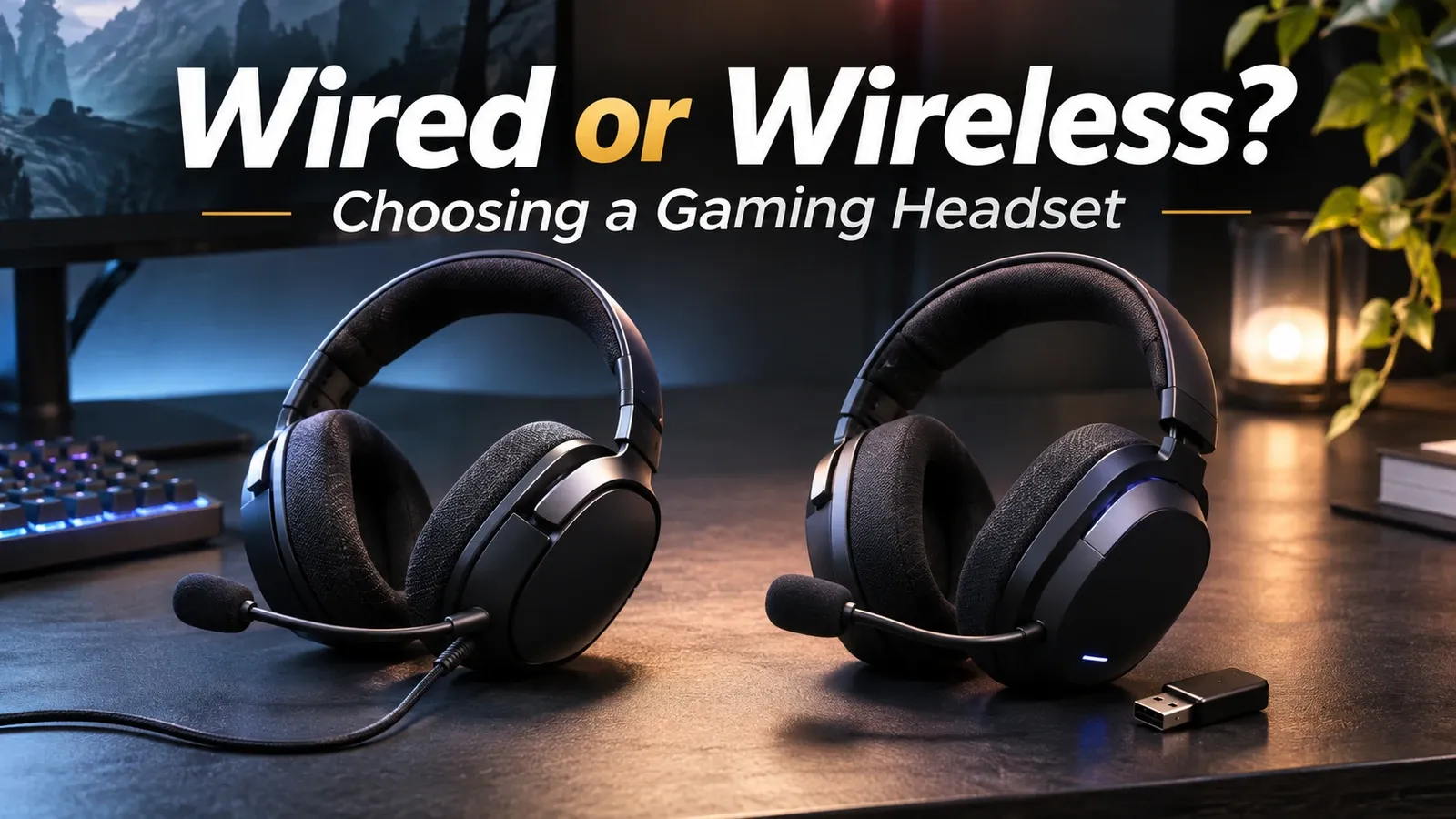
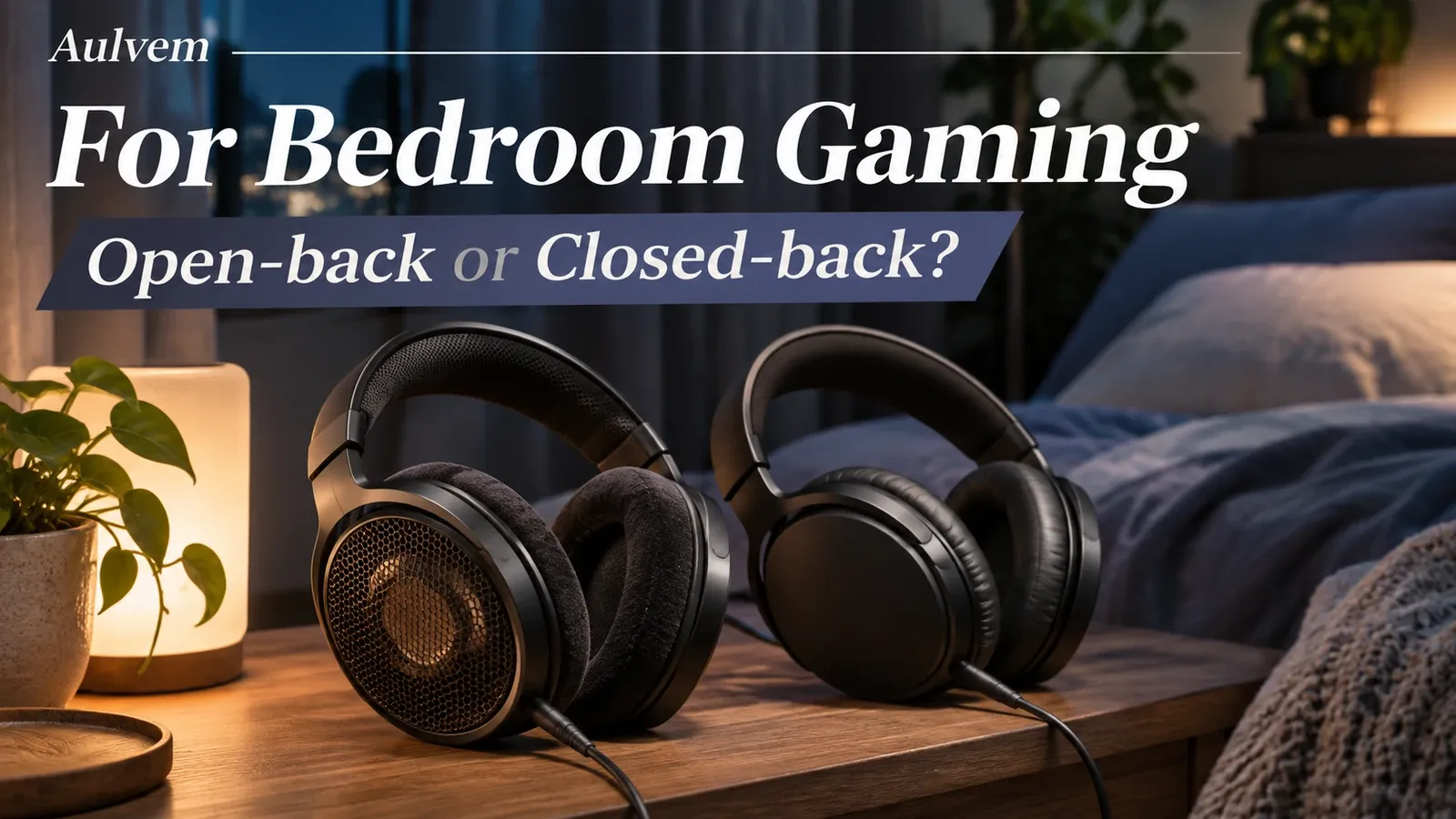
In this guide, if someone sleeps in the same room, start with closed-back; if you play alone, open-back is also an option. An open-back cup is open at the back by design, and no maker page checked gives a figure for how much it leaks, so closed-back is the safer choice.
Everything here rests on the makers’ official specs and pages. No headset was tested in hand. The table below shows which design fits each bedroom situation.
Open-back vs closed-back by bedroom situation
Start with closed-back if someone sleeps in the room; open-back is also an option if you play alone for long sessions. Neither design has an official figure for fan noise in the pages checked.
An open-back cup leaves the back of each earcup open so sound passes through. A closed-back cup has a solid back.
A check mark means the safer choice for that situation. A triangle means the cup is open at the back by design, or no official figure was found. Volume and room size are not in the table.
| Bedroom situation | Open-back | Closed-back |
|---|---|---|
| Someone sleeps in the same room | △ Open at the back by design | ✓ The safer choice |
| The AC or PC fans bother you | △ No official figure | △ No official figure |
| You play long sessions alone | △ No official figure | △ No official figure |
Open-back or closed-back in the bedroom?
Pick your bedroom situation, wired or wireless, and how long you play a day. It shows the same call as the table above and the pick for that case (with battery days for wireless).
For these settings
For these settings
For these settings
Sound leaking to someone asleep in the room
Per the official specs of the models checked, no figure shows how much sound leaks, or whether a low volume at night keeps it from someone asleep nearby. That can’t be promised for either design.
AC and PC fan noise
No US maker page checked gives a figure for how much outside noise, such as an AC unit or PC fans, gets through either design. None says how well you can still hear someone in the house through a closed-back headset, either.
Heat and weight in long sessions
For long sessions, no US maker page checked gives figures for heat, and the open-back or closed-back label alone doesn’t tell you how light a headset is.
Official weights overlap between the two designs: models listed as open-back weigh 207-235 g (7.3-8.3 oz). Closed-back ones weigh 190-358 g (6.7-12.6 oz). All the open-back figures are Audio-Technica’s, taken from its Japan pages for the same model numbers, and whether the cord or mic is included varies, so compare model by model.
Voice chat and the mic with someone asleep nearby
For voice chat with someone asleep in the room, separate what the mic sends to the call from your own voice reaching the sleeper directly.
What reaches the call depends on the mic’s mute and pickup pattern. Per the official specs, the open-back pick’s mic has a mute switch, and the closed-back wired pick’s mutes when swiveled up. The wireless pick’s page doesn’t say how its mic mutes.
The makers list the open-back pick’s mic as hypercardioid and the wireless pick’s as unidirectional. Both are directional patterns that mainly pick up sound from the front. The wired pick’s page doesn’t state a pattern.
Muting the mic doesn’t quiet your own voice in the room. No official source checked says a headset changes how far your voice carries, so while someone is asleep, it’s safest to avoid talking on voice chat.
In the sources checked, no maker explains whether game audio from open-back cups reaches the mic.
Picks by situation
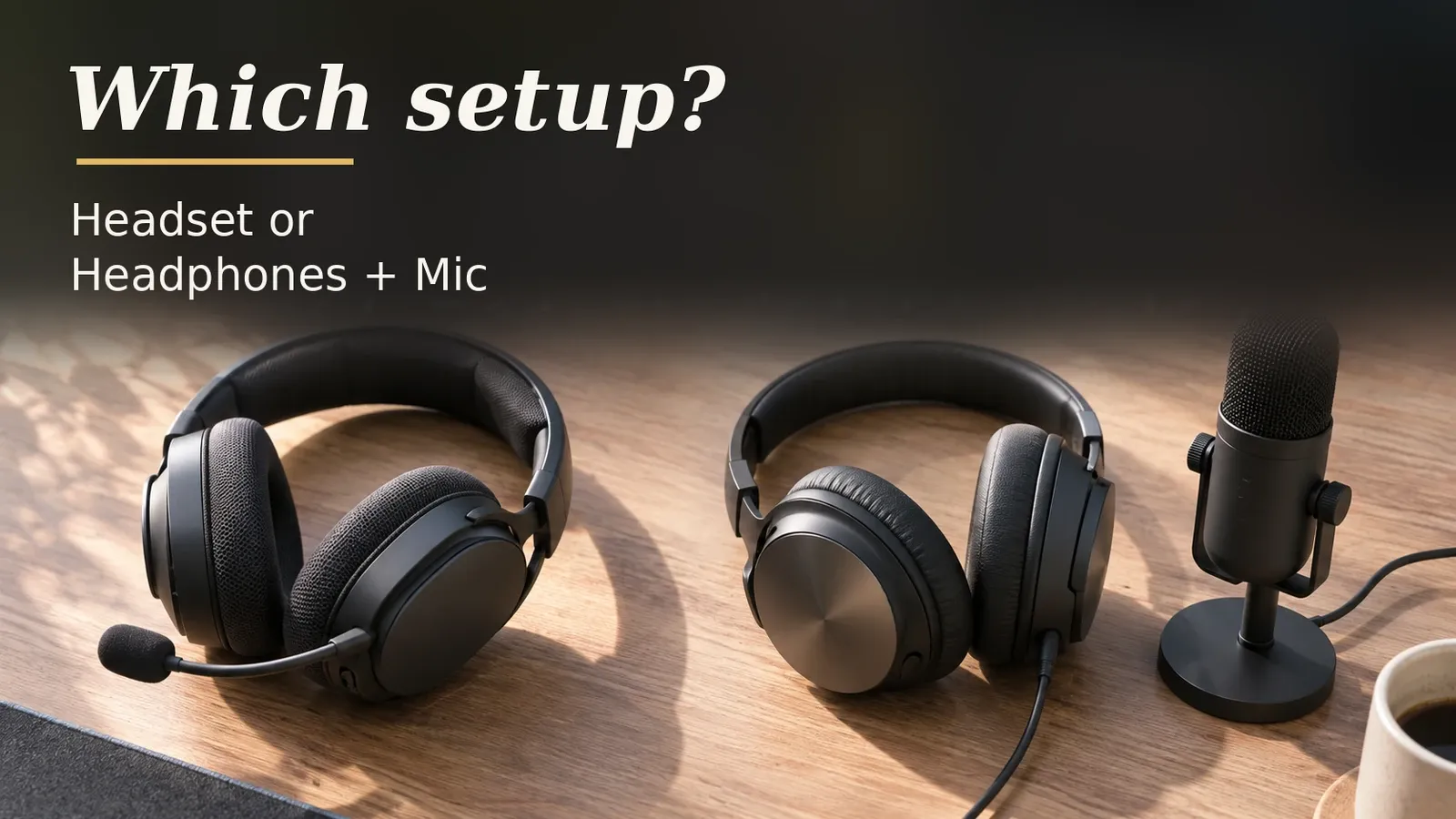
The picks are a closed-back wired or wireless headset if someone sleeps in the room, and an open-back headset with a mic if you play alone.
Open-back for playing alone
It’s a wired gaming headset that Audio-Technica’s spec page (its Japan site; the US page couldn’t be retrieved) lists as open-back, with a detachable hypercardioid mic and a mute switch. It weighs 220 g (7.8 oz) without the mic. With the mic it’s 227 g (8.0 oz), and neither figure includes the cord. Of the models checked, it is the only open-back headset with a mic that met the slot conditions on official specs and had an Amazon.com listing meeting the bar. The Drop PC38X listing also met the bar, but its official spec page couldn’t be retrieved, so its open-back design wasn’t confirmed.
Closed-back and wired, with someone asleep in the room
It’s a wired closed-back headset at about 272 g (9.6 oz). The page doesn’t say whether the cable or mic is included. The mic mutes when you swivel it up.
The rating count is shared with other models on the same listing.
Closed-back and wireless, with someone asleep in the room
It’s a 2.4 GHz wireless closed-back headset at about 295 g (10.4 oz), with up to 20 hours on the USB dongle, and PS5 is in its official compatibility list. At 3 hours a day (assumed), its 20-hour maximum lasts 6 days. Maker figures are best-case values, and real use can be shorter.
Of the models checked here, the closed-back wired and wireless picks are the cheapest that met the slot conditions and had an Amazon.com listing meeting the bar. The open-back headset with a mic is the only model that met both, so it had no cheaper rival. Models left out, and why, are in the data section at the end.
Each listing needed 100 or more ratings, 4.0 stars or higher, and a seller that is Amazon.com or the brand. Check the price on the store page before buying.
On Amazon.com prices from the November 1, 2026 selection log, taking the closed-back wired pick as 1, the open-back pick costs about 4.6 times as much. The closed-back wireless pick costs about 1.7 times. These are ratios of Amazon.com prices for the picks, not maker claims.
FAQ
Do open-back headphones leak sound? Will a low volume at night keep it from someone asleep nearby?
An open-back cup is open at the back by design. No maker figure checked shows how much leaks, so a low volume at night can’t be promised to keep it from someone asleep nearby.
Is closed-back better if the AC or PC fans bother me?
An official figure for how much AC or PC fan noise gets through either design wasn’t found in the pages checked, so this guide doesn’t rank the two for it.
Does an open-back headset’s mic pick up room noise?
How much room sound the mic picks up depends on its pickup pattern. Per the makers’ specs, the open-back pick’s mic is hypercardioid and the closed-back wireless pick’s is unidirectional.
Both are directional patterns that mainly pick up sound from the front. The closed-back wired pick’s page doesn’t state a pattern.
Does game audio leak into the mic on open-back headsets?
No maker explanation was found in the sources checked for this guide on whether game audio from open-back cups reaches the mic.
Is open-back better for FPS games?
No maker figure checked shows open-back helps in FPS. Decide first by whether someone sleeps in the room.
Are open-back headphones less sweaty? Are they good for a summer bedroom?
No US maker page checked gives figures for heat or comfort over long sessions, so check each model’s weight and ear pads instead.
Data and formulas used (for verification)
How this was checked: This guide uses the official spec pages of major makers and Amazon.com listings as of November 2026. No headset was tested in hand, so nothing here describes how leakage or fit feels. The data section at the end lists the models checked, the ones left out and why, and the weights. Sound quality isn’t compared, because an official figure for which design sounds better wasn’t found in the sources checked.
Method
- Covers current gaming headsets, open-back headphones and USB mics from major makers (Audio-Technica, Sennheiser, HyperX, Razer, Sony, Turtle Beach and others) per their official specs, and Amazon.com listings, as of November 1, 2026. No product was tested in hand.
- Only the makers’ official specs are used for numbers. No third-party measurements. No official figure was found for how much sound leaks, how much outside sound gets in, or how much game audio reaches the mic. The open-back and closed-back explanations used in the Japanese edition come from Audio-Technica’s Japanese explainers and are not used here; no US maker page checked for this guide gives such an explanation with figures.
- The marks in the table are this guide’s own judgment from the structure alone: open-back means the back of the cup is open by design. A check mark is the safer choice for that situation; a triangle means open at the back by design, or no official figure. Volume and room size are not included.
- Open-back or closed-back is taken from each model’s official spec wording (models with no such wording, or with only a search-result summary, are left out of both).
- Days per charge = the maker’s official maximum battery hours ÷ hours of use per day (assumed 1-3 hours), rounded down. Official battery hours are best-case figures under stated conditions.
- Weights are the makers’ official figures (whether the cord or mic is included follows each page). Several US rows reuse values from the maker’s Japan page for the same model number; the data table marks them.
- Picks are the cheapest model that meets the slot conditions on official specs and whose Amazon listing has 100+ ratings, 4+ stars, is new, and is sold by Amazon or the brand (checked November 1, 2026). Where only one listing met the conditions, that one is the pick. Price ratios come from Amazon prices in the selection log, not from the makers.
Open-back / closed-back and weight of the models checked (US rows; only models whose official specs say open-back or closed-back; official weights)
| Model | Official wording | Type in this guide | Weight (official) | Source |
|---|---|---|---|---|
| Razer BlackShark V2 X | Closed-back | Closed-back wired | 240 g (cable or mic not stated) | razer.com |
| HyperX Cloud III | Closed-back | Closed-back wired | 304 g (cable or mic not stated) | hyperx.com |
| Sony INZONE H3 MDR-G300 | Closed-back | Closed-back wired | 299 g (cord excluded) | sony.jp (Japan page values) |
| HyperX Cloud III S Wireless | Closed-back | Closed-back 2.4 GHz | 358 g (cable or mic not stated) | hyperx.com |
| HyperX Cloud Stinger 2 Wireless | Closed-back | Closed-back 2.4 GHz | 272 g (cable or mic not stated) | hyperx.com |
| Sony INZONE H5 WH-G500 | Closed-back | No slot (mic or connection not confirmed) | 260 g (cable or mic not stated) | helpguide.sony.net (Japan page values) |
| Sony INZONE H9 WH-G900N | Closed-back | Closed-back 2.4 GHz | 330 g (cable or mic not stated) | sony.jp (Japan page values) |
| Sony WH-CH720N | Closed-back | No slot (mic or connection not confirmed) | 192 g (cable or mic not stated) | sony.jp (Japan page values) |
| Audio-Technica ATH-M20x | Closed-back | Closed-back headphones (no slot) | 190 g (cord excluded) | audio-technica.co.jp (Japan page values) |
| Audio-Technica ATH-M30x | Closed-back | Closed-back headphones (no slot) | 220 g (cord excluded) | audio-technica.co.jp (Japan page values) |
| Philips SHP9500 | Open-back | No slot (mic or connection not confirmed) | No official figure | usa.philips.com |
| Audio-Technica ATH-GDL3 | Open-back | Open-back headset | 220 g (cord excluded) | audio-technica.co.jp (Japan page values) |
| HyperX Cloud Stinger 2 Core | Closed-back | Closed-back wired | 272 g (cable or mic not stated) | hyperx.com |
| Turtle Beach Recon 70 | Closed-back | Closed-back wired | No official figure | turtlebeach.com |
| HyperX Cloud Alpha | Closed-back | Closed-back wired | 295 g (cable or mic not stated) | hyperx.com |
| HyperX Cloud Alpha Wireless | Closed-back | Closed-back 2.4 GHz | 318 g (cable or mic not stated) | hyperx.com |
| HyperX Cloud Jet | Closed-back | Closed-back 2.4 GHz | 295 g (cable or mic not stated) | hyperx.com |
| Sennheiser HD 599 | Open-back | Open-back headphones | No official figure | sennheiser-hearing.com |
| Audio-Technica ATH-AD500X | Open-back | Open-back headphones | 235 g (cord excluded) | audio-technica.co.jp (Japan page values) |
| Audio-Technica ATH-R50x / R30x | Open-back | Open-back headphones | 207 g (cord excluded) | audio-technica.co.jp (Japan page values) |
| beyerdynamic DT 990 PRO | Open-back | No slot (mic or connection not confirmed) | No official figure | beyerdynamic.com |
- Left out of both (no open/closed wording in the official specs, or the specs couldn’t be retrieved): Logitech G G335, SteelSeries Arctis Nova 1, HyperX Cloud Stinger 2, Corsair HS55 STEREO, Razer Barracuda X, Logitech G G435 LIGHTSPEED & Bluetooth, SteelSeries Arctis Nova 5 Wireless, Corsair HS55 WIRELESS, Logitech G G733 LIGHTSPEED, Turtle Beach Stealth 600 Gen 3, Logitech G G PRO X 2 LIGHTSPEED, Razer Barracuda, Razer Opus X, Logitech Zone Vibe 100, Sony MDR-7506, Sennheiser HD 560S, Audio-Technica ATH-GL3, Audio-Technica ATH-ADG1 / ADG1X, Anker Soundcore Space One, Logitech G G325 LIGHTSPEED, Logitech G G535 LIGHTSPEED, Logitech G G432, Logitech G G321 LIGHTSPEED, HyperX Cloud Flight 2, Razer BlackShark V3 X HyperSpeed, Corsair HS65 SURROUND, Corsair HS80 MAX WIRELESS, Turtle Beach Stealth 700 Gen 3, JBL Quantum 200 / Quantum 100, Razer Kraken V4 X, Drop PC38X.
- Weight ranges (models above with an official figure): open-back 207-235 g, closed-back 190-358 g. Rows marked “Japan page values” reuse the maker’s Japan page for the same model number.
Pick prices (Amazon.com, checked November 1, 2026; the body shows ratios only)
| Slot | Pick | Price |
|---|---|---|
| a wired gaming headset with a mic, listed as open-back in the official specs | Audio-Technica ATH-GDL3 | $139.00 |
| a wired (3.5 mm or USB) gaming headset with a mic, listed as closed-back in the official specs | HyperX Cloud Stinger 2 Core | $29.99 |
| a 2.4 GHz wireless gaming headset with a mic, listed as closed-back in the official specs, with an official battery figure | HyperX Cloud Jet | $49.97 |
- Ratios to the closed-back wired pick (HyperX Cloud Stinger 2 Core): Open-back pick: 139 ÷ 29.99 ≈ 4.635 → about 4.6x; Closed-back wireless pick: 49.97 ÷ 29.99 ≈ 1.666 → about 1.7x.
- Days at 3 hours a day (assumed): floor(20 ÷ 3) = 6 (20 at 1 hour a day).
- Left out of the open-back headset slot: Sennheiser HD 560S (listing meets the bar, but only a search-result summary of the official specs was available); Sennheiser HD 599 (listing meets the bar, but headphones without a mic); Audio-Technica ATH-AD500X (listing meets the bar and costs less than the pick, but headphones without a mic); Audio-Technica ATH-R50x / R30x (listing meets the bar, but headphones without a mic); Drop PC38X (listing meets the bar, but the official spec page couldn’t be retrieved, so open-back or closed-back is unconfirmed); Sony INZONE H6 Air (listing outside the bar: fewer than 100 ratings; official specs for this market were not collected); EPOS H6PRO Open Acoustic (listing outside the bar: shipping cost unknown, sold by neither Amazon nor the brand; official specs for this market were not collected); Turtle Beach Atlas Air (listing outside the bar: no new listing, shipping cost unknown, under 4 stars, sold by neither Amazon nor the brand; official specs for this market were not collected); FIFINE (listing outside the bar: no new listing, shipping cost unknown, fewer than 100 ratings, sold by neither Amazon nor the brand; official specs for this market were not collected).
- Left out of the closed-back wired slot: JBL Quantum 200 / Quantum 100 (listing meets the bar and costs less than the pick, but the official spec page couldn’t be retrieved, so open-back or closed-back is unconfirmed).
- Region: the ATH-GDL3 figures come from Audio-Technica’s Japan page (the US page returned 403).
- Not checked: official explanations or figures for how much sound leaks, how much outside sound gets in, or how much game audio reaches the mic. No source says whether someone in the same room hears it at a low volume at night.
Assumptions
- Hours a day (a night) the headset runs on battery in the bedroom. This is an assumption, not a measured fact. Days between charges use the high end, 3 hours, so the estimate errs short.: 3 (1–3)
Open-back or closed-back in the bedroom?: quick reference
The calculator in this article shows the result and a matching product for your own settings. Settings can be set in the URL; each link below opens the calculator with those settings.
| Settings | Result | Calculator |
|---|---|---|
| Someone sleeps in the same room, Wired is fine, 3 | ✓ Closed-back is the safer choice. Open-back: △ Open at the back by design / Closed-back: ✓ The safer choice. An open-back cup is open at the back by design, so sound passes through. Volume and room size aren’t included in this call | Open with these settings |
| Someone sleeps in the same room, No cable, 3 | ✓ Closed-back, 6 days per charge. Pick’s official max 20 h ÷ 3 h a day = 6 days (rounded down). Open-back: △ Open at the back by design / Closed-back: ✓ The safer choice. Maker figures are best-case values, and real use can be shorter. An open-back cup is open at the back by design, so sound passes through. Volume and room size aren’t included in this call | Open with these settings |
| Someone sleeps in the same room, No cable, 1 | ✓ Closed-back, 20 days per charge. Pick’s official max 20 h ÷ 1 h a day = 20 days (rounded down). Open-back: △ Open at the back by design / Closed-back: ✓ The safer choice. Maker figures are best-case values, and real use can be shorter. An open-back cup is open at the back by design, so sound passes through. Volume and room size aren’t included in this call | Open with these settings |
| Someone sleeps in the same room, No cable, 6 | ✓ Closed-back, 3 days per charge. Pick’s official max 20 h ÷ 6 h a day = 3 days (rounded down). Open-back: △ Open at the back by design / Closed-back: ✓ The safer choice. Maker figures are best-case values, and real use can be shorter. An open-back cup is open at the back by design, so sound passes through. Volume and room size aren’t included in this call | Open with these settings |
| The AC or PC fans bother you, Wired is fine, 3 | △ No official figure for either type. Open-back: △ No official figure / Closed-back: △ No official figure. An open-back cup is open at the back by design, so sound passes through. Volume and room size aren’t included in this call | Open with these settings |
| You play long sessions alone, Wired is fine, 3 | △ No official figure for either type. Open-back: △ No official figure / Closed-back: △ No official figure. An open-back cup is open at the back by design, so sound passes through. Volume and room size aren’t included in this call | Open with these settings |
| You play long sessions alone, No cable, 3 | △ No official figure for either type. Open-back: △ No official figure / Closed-back: △ No official figure. The open-back pick is wired only (there’s no wireless open-back pick). An open-back cup is open at the back by design, so sound passes through. Volume and room size aren’t included in this call | Open with these settings |