Contents14
- Energy used per hour and per month
- How the cost is worked out, and the rate source
- Space heater vs heat pump
- Lower settings, overnight use and safety
- Check your own numbers
- Picks by situation
- If you want a published low setting
- If you want a thermostat and ECO mode
- FAQ
- How much electricity does a space heater use per hour?
- How many kWh does a space heater use in a month?
- How much power does a space heater use overnight?
- Is a space heater cheaper than a heat pump?
- Does the thermostat or timer cut the electric bill?
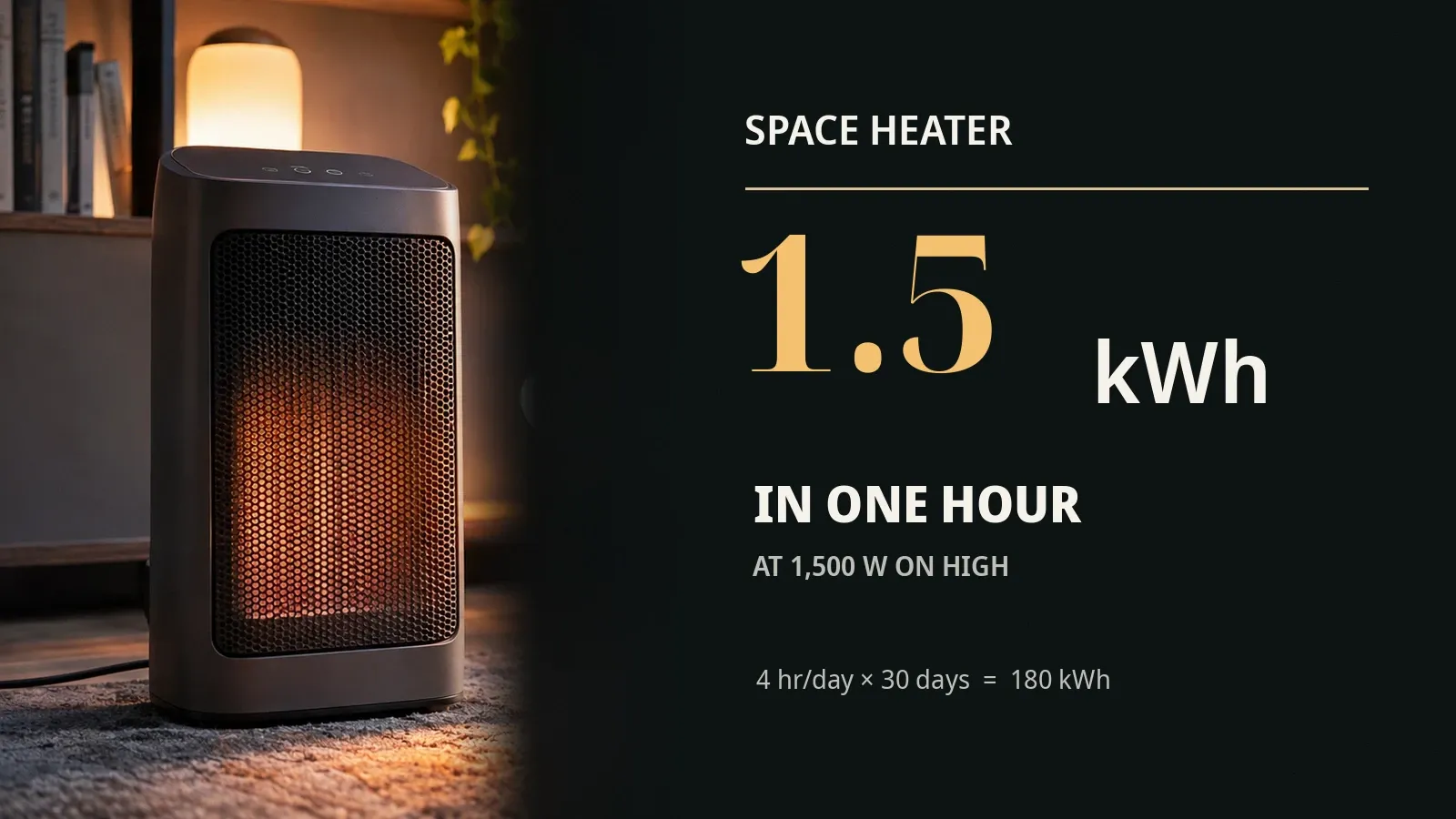
Per the makers’ U.S. specs, a 1,500 W space heater on high uses 1.5 kWh an hour. On the two models with a published low wattage, the lowest setting uses about 0.6–0.7 times that for the same hours.
A kWh (kilowatt-hour) is the unit on your electric bill. Multiply the wattage by the hours of use and divide by 1,000 to get kWh, then multiply by your rate per kWh to get dollars.
This guide works from the makers’ U.S. specs as of November 2026. The text gives kWh, and the dollar figures sit only in the data section at the end.
Energy used per hour and per month
Assuming 4 hours a day for 30 days, 1,500 W comes to 180 kWh a month and 900 W to 108 kWh. Halve the hours and the energy halves too.
The table shows the published settings of the two models, worked out for 4 hours a day over 30 days.
| Setting | Power | Energy in 1 hour | Energy in a month |
|---|---|---|---|
| High on both models | 1,500 W | 1.5 kWh | 180 kWh |
| Lowest published setting (900 W model) | 900 W | 0.9 kWh | 108 kWh |
| Lowest published setting (1,000 W model) | 1,000 W | 1 kWh | 120 kWh |
Space heater energy calculator
Enter your heater's wattage and how many hours a day you run it. It shows the energy for one hour and for a month (30 days), plus the pick for the feature you choose.
For these settings
For these settings
Scale the 4 hours to how long you actually run the heater.
How the cost is worked out, and the rate source
Per EIA data, the U.S. residential average was 18.16 cents/kWh in August 2026 and 17.23 cents/kWh for 2025. Rates differ by utility and plan, so the rate on your own bill is what counts; cost is kWh times that rate.
Per the makers’ U.S. specs, high (1,500 W) uses 1.5 kWh an hour; the lowest settings of 900 W and 1,000 W use 0.9 and 1.0 kWh. The cost for each wattage at the EIA average is in the table in the data section at the end.
Space heater vs heat pump
According to the U.S. Department of Energy, heat pumps are the most efficient form of electric heating, giving up to 3 times more heat than the energy they use. They can cut heating electricity by approximately 50% compared with electric furnaces or baseboard heaters.
That compares whole-house heating systems. Heating one room with a space heater versus the whole house with a heat pump wasn’t compared, because no public figure for it was found in the sources checked.
Heat pump power draw varies with outdoor temperature and the unit. An official figure for a short run wasn’t found in the sources checked, so this guide doesn’t say which is cheaper over a few hours.
Lower settings, overnight use and safety
On the two models with a published low wattage, low uses about 0.6–0.7 times the energy of high for the same hours.
Working from wattage and hours, running 1,500 W for 8 hours would use 12 kWh, but the CPSC says to turn heaters off when sleeping.
According to the CPSC and NFPA, plug a space heater directly into a wall outlet, never an extension cord or power strip. Keep it at least 3 feet from anything that can burn, and choose one that shuts off if it tips over.
Check your own numbers
- Find the wattage for high and low on the label or in the manual.
- Decide how many hours a day and how many days you’ll run it.
- Multiply watts by hours and divide by 1,000 to get kWh.
- Multiply by the rate on your bill for a dollar estimate.
Example: 1,500 W × 4 hours × 30 days ÷ 1,000 comes to 180 kWh.
Picks by situation
Picks are sold new by Amazon.com or the brand, with 100+ ratings and 4.0+ stars. Of the models checked here, the cheapest one that meets that pick’s condition is the pick. Listings were checked on Amazon.com on November 5, 2026; check current prices there.
If you want a published low setting
Lasko CD08200 is the pick for a published low setting. It runs from 900 W to 1,500 W per Lasko’s page, so its lowest setting is about 0.6 times high, and its specs list no adjustable thermostat. A tip-over shutoff wasn’t found on Lasko’s product page, so check the manual for one before buying.
If you want a thermostat and ECO mode
DREO Atom One is the pick for a thermostat and ECO mode. It has a 41–95°F digital thermostat and an ECO mode, and runs 1,000–1,500 W with a 1–12 hour timer and overheat and tip-over protection.
FAQ
How much electricity does a space heater use per hour?
Per the makers’ U.S. specs, high (1,500 W) uses 1.5 kWh an hour; the lowest settings of 900 W and 1,000 W use 0.9 and 1.0 kWh.
How many kWh does a space heater use in a month?
Assuming 4 hours a day for 30 days, 1,500 W comes to 180 kWh a month and 900 W to 108 kWh. Halve the hours and the energy halves too.
How much power does a space heater use overnight?
Working from wattage and hours, running 1,500 W for 8 hours would use 12 kWh, but the CPSC says to turn heaters off when sleeping.
Is a space heater cheaper than a heat pump?
According to the U.S. Department of Energy, heat pumps are the most efficient form of electric heating, giving up to 3 times more heat than the energy they use. They can cut heating electricity by approximately 50% compared with electric furnaces or baseboard heaters.
That compares whole-house heating systems. Heating one room with a space heater versus the whole house with a heat pump wasn’t compared, because no public figure for it was found in the sources checked.
An official short-run figure wasn’t found in the sources checked, so which is cheaper over a few hours isn’t stated.
Does the thermostat or timer cut the electric bill?
Yes, by the time the thermostat or timer keeps the heat off. How much depends on your room and how you use it, so this guide doesn’t estimate it.
Data and formulas used (for verification)
Related guides:
- Can You Use a Space Heater in a Bathroom?
- Will a Heater Fit Under Your Desk?
- Space Heater Motion Sensor: How Long Until It Shuts Off?
- Do You Need a Humidifier With a Space Heater?
How this was checked: Figures come from the makers’ U.S. spec pages for two space heaters, EIA rate data and DOE guidance as of November 2026. Nothing was tested by hand. The formula, sources and per-model figures are in the data section at the end of the page.
Method
- Covers space heaters sold on Amazon.com, checked November 5, 2026. Only two (Lasko CD08200 and DREO Atom One) have a wattage range in the maker’s U.S. specs; the other listings are in the data section. Nothing was tested hands-on.
- Energy (kWh) = watts × hours ÷ 1,000. Cost = kWh × your rate. The U.S. residential average was 18.16 cents/kWh in August 2026 and 17.23 cents/kWh for 2025 (EIA Electric Power Monthly, Table 5.3). A month is 30 days; 1–8 hours a day is an assumption.
- Heat pumps are compared only through the U.S. Department of Energy’s statements. No public figure comparing one heated room with heating the whole house was found, so that is not compared.
- Picks: among models that meet the slot condition in the official specs, listings with 100+ ratings and 4+ stars, sold by Amazon.com or the brand, at a new price. The cheapest wins.
Official wattage and controls (makers’ U.S. pages)
| Model | Wattage | Thermostat | ECO mode | Safety and timer | Source |
|---|---|---|---|---|---|
| Lasko CD08200 | 900 W to 1,500 W, 120 V | No | No | Overheat protection; ALCI safety plug; one-touch button for one hour of high heat (tip-over shutoff not found on the page) | lasko.com |
| DREO Atom One | 1,000 to 1,500 W, 120 V (H1/H2/H3/ECO/Fan) | 41 to 95°F | Yes | Overheat and tip-over protection; 1 to 12 h timer | dreo.com |
Cost at the U.S. average rate (18.16 cents/kWh, EIA, August 2026)
| Use | 1,500 W (high) | 1,000 W (lowest on one model) | 900 W (lowest on another model) |
|---|---|---|---|
| 1 h a day × 30 days | 45 kWh · $8.17 | 30 kWh · $5.45 | 27 kWh · $4.90 |
| 2 h a day × 30 days | 90 kWh · $16.34 | 60 kWh · $10.90 | 54 kWh · $9.81 |
| 4 h a day × 30 days | 180 kWh · $32.69 | 120 kWh · $21.79 | 108 kWh · $19.61 |
| 8 h a day × 30 days | 360 kWh · $65.38 | 240 kWh · $43.58 | 216 kWh · $39.23 |
- One hour: 1,500 W is 27.2 cents, 1,000 W is 18.2 cents, 900 W is 16.3 cents. At the 2025 average (17.23 cents/kWh), 1,500 W for an hour is 25.8 cents.
- Rate source: EIA Electric Power Monthly, Table 5.3 (U.S. total, residential). Your utility’s rate may be higher or lower; cost scales with it.
- Heat pumps: the U.S. Department of Energy says heat pumps are the most efficient form of electric heating, giving up to three times more heat than the energy they use, and can cut heating electricity by about 50% versus electric furnaces or baseboard heaters (energy.gov). No public figure comparing one heated room with whole-house heating was found.
- The low-setting wattage is the bottom of each maker’s published range. Warmth (heat output) isn’t compared.
- Low setting slot, left out: DREO space heater (B097RG67QB): the maker’s U.S. specs weren’t checked for this listing’s model; DREO space heater (B0C6FCKQML): the maker’s U.S. specs weren’t checked for this listing’s model; DREO space heater (B095PP1GZR): the maker’s U.S. specs weren’t checked for this listing’s model; Amazon Basics ceramic space heater (B07V6M3PDX): the maker’s U.S. specs weren’t checked for this listing’s model; PELONIS 23-inch tower heater (B07YDBCYT3): the maker’s U.S. specs weren’t checked for this listing’s model; Honeywell HCE323V: the wattage isn’t in Honeywell’s official page.
- Thermostat and ECO slot, left out: DREO space heater (B097RG67QB): the maker’s U.S. specs weren’t checked for this listing’s model; DREO space heater (B0C6FCKQML): the maker’s U.S. specs weren’t checked for this listing’s model; DREO space heater (B095PP1GZR): the maker’s U.S. specs weren’t checked for this listing’s model; Amazon Basics ceramic space heater (B07V6M3PDX): the maker’s U.S. specs weren’t checked for this listing’s model; PELONIS 23-inch tower heater (B07YDBCYT3): the maker’s U.S. specs weren’t checked for this listing’s model; Honeywell HCE323V: the wattage isn’t in Honeywell’s official page.
- Thermostat and ECO slot: 1 of the checked models met the condition.
- Listings: checked on Amazon.com on November 5, 2026, sold by Amazon.com, showing a new price. The model on the listing was matched by title; the buy box’s New label wasn’t confirmed.
Official values used
| Item | Value | Source | Checked |
|---|---|---|---|
| US residential average electricity price (EIA) | EIA Electric Power Monthly Table 5.3: U.S. total residential average price 18.16 cents/kWh in August 2026 (latest month); 17.23 cents/kWh for full-year 2025. cents/kWh | eia.gov Table 5.3. Average Price of Electricity to Ultimate Customers: Residential (U.S. | 2026-11-05 |
| Heat pump vs electric resistance heating (DOE) | Heat pumps provide up to three times more heat than the energy they use; about 50% less electricity for heating than electric furnaces or baseboard heaters | energy.gov They are the most efficient form of electric heating, providing up to three time | 2026-11-05 |
| Plug a space heater directly into a wall outlet (CPSC, NFPA) | Plug electric space heaters directly into a wall outlet, never an extension cord or power strip. | cpsc.gov Plug electric space heaters directly into a wall outlet—never into an extension | 2026-11-05 |
| Keep space heaters 3 feet from combustibles (CPSC, NFPA) | Keep portable heaters at least 3 feet from drapes, furniture, bedding and other combustible materials. | cpsc.gov Keep portable heaters at least three feet away from drapes, furniture, bedding a | 2026-11-05 |
| Turn heaters off when sleeping (CPSC) | CPSC: Turn off heaters when sleeping. | cpsc.gov Turn off heaters when sleeping. | 2026-11-05 |
| Look for auto shut-off if tipped over (NFPA) | NFPA: make sure the heater has an auto shut-off that turns it off if it tips over. | content.nfpa.org Make sure your heater has an auto shut-off to turn the heater off if it tips ove | 2026-11-05 |
Space heater energy calculator: quick reference
The calculator in this article shows the result for your own settings. Settings can be set in the URL; each link below opens the calculator with those settings.
| Settings | Result | Calculator |
|---|---|---|
| 1500, 4, A published low setting | 180 kWh a month (30 days). 1,500 W for 4 hours a day over 30 days uses 1.5 kWh an hour and 180 kWh a month (1,500 W × 4 h × 30 days ÷ 1,000). On the two models with a published low wattage, low uses about 0.6–0.7 times the energy of high for the same hours. Plug a space heater directly into a wall outlet, never an extension cord or power strip. Keep it at least 3 feet from anything that can burn, and choose one that shuts off if it tips over. A tip-over shutoff wasn’t found on Lasko’s product page, so check the manual for one before buying | Open with these settings |
| 900, 4, A published low setting | 108 kWh a month (30 days). 900 W for 4 hours a day over 30 days uses 0.9 kWh an hour and 108 kWh a month (900 W × 4 h × 30 days ÷ 1,000). On the two models with a published low wattage, low uses about 0.6–0.7 times the energy of high for the same hours. Plug a space heater directly into a wall outlet, never an extension cord or power strip. Keep it at least 3 feet from anything that can burn, and choose one that shuts off if it tips over. A tip-over shutoff wasn’t found on Lasko’s product page, so check the manual for one before buying | Open with these settings |
| 1000, 4, Thermostat and ECO mode | 120 kWh a month (30 days). 1,000 W for 4 hours a day over 30 days uses 1 kWh an hour and 120 kWh a month (1,000 W × 4 h × 30 days ÷ 1,000). Time the thermostat or timer keeps the heat off isn’t counted here. Plug a space heater directly into a wall outlet, never an extension cord or power strip. Keep it at least 3 feet from anything that can burn, and choose one that shuts off if it tips over | Open with these settings |
| 1500, 8, Thermostat and ECO mode | 360 kWh a month (30 days). 1,500 W for 8 hours a day over 30 days uses 1.5 kWh an hour and 360 kWh a month (1,500 W × 8 h × 30 days ÷ 1,000). Time the thermostat or timer keeps the heat off isn’t counted here. Plug a space heater directly into a wall outlet, never an extension cord or power strip. Keep it at least 3 feet from anything that can burn, and choose one that shuts off if it tips over | Open with these settings |
| 1500, 1, A published low setting | 45 kWh a month (30 days). 1,500 W for 1 hour a day over 30 days uses 1.5 kWh an hour and 45 kWh a month (1,500 W × 1 h × 30 days ÷ 1,000). On the two models with a published low wattage, low uses about 0.6–0.7 times the energy of high for the same hours. Plug a space heater directly into a wall outlet, never an extension cord or power strip. Keep it at least 3 feet from anything that can burn, and choose one that shuts off if it tips over. A tip-over shutoff wasn’t found on Lasko’s product page, so check the manual for one before buying | Open with these settings |