Contents14
- Quick guide: which panel for which use
- What each panel type does best
- How to check a spec sheet
- Reading viewing angle and response time numbers
- OLED burn-in warranty by maker and country
- Picks by use
- Office work, IPS
- Movies and games in a dark room, VA
- OLED with burn-in coverage stated on the maker’s US page
- FAQ
- IPS or VA: which is better?
- Is the viewing angle the same on IPS and VA?
- Can you compare response times in GtG and MPRT?
- Does the warranty cover OLED burn-in?
Among current models from major brands, VA or OLED suit dark-room movies and games, IPS suits office work, and TN or OLED suit high refresh rates. Stated contrast is 1,000:1–1,500:1 for IPS and 3,000:1–5,000:1 for VA, against 1,000,000:1–1,500,000:1 for OLED.
As of October 2026, this compares current models from Dell, LG, ASUS, MSI and other major brands on their official specs, plus each maker’s warranty page. If you’re unsure, find the row below that matches how you use the monitor. None of the models was tested in person, so there’s no verdict on how they look.
Quick guide: which panel for which use
Assumptions: spec-sheet numbers for current models from major brands; none of the models was tested in person. Refresh rate (Hz) is how many times per second the screen updates.
| Use | Panel to consider | Spec behind it |
|---|---|---|
| Movies and games in a dark room | VA or OLED | Contrast: VA 3,000:1–5,000:1, OLED 1,000,000:1–1,500,000:1; IPS and TN 1,000:1–1,500:1 |
| Competitive FPS and fighting games | TN or OLED | Max refresh: TN 280Hz–600Hz, OLED 240Hz–360Hz, VA 165Hz–280Hz, IPS 100Hz–180Hz. The VA range overlaps TN and OLED, so refresh rate alone doesn’t separate VA from them. OLED response time is 0.03 ms (GtG) on every model |
| Office work, or viewing from an angle | IPS | Spec viewing angles are 178°/178° for IPS, VA and OLED alike. EIZO says that among LCDs (IPS, VA, TN) IPS shows the least change in brightness and color from an angle. There is no source comparing OLED |
When no row fits, go by this:
- Not sure: IPS if you want an LCD. EIZO says that among LCDs it shows the least change in brightness and color from an angle
- Deeper blacks matter most: VA
- OLED: check the maker’s warranty page for your country before you buy
What each panel type does best
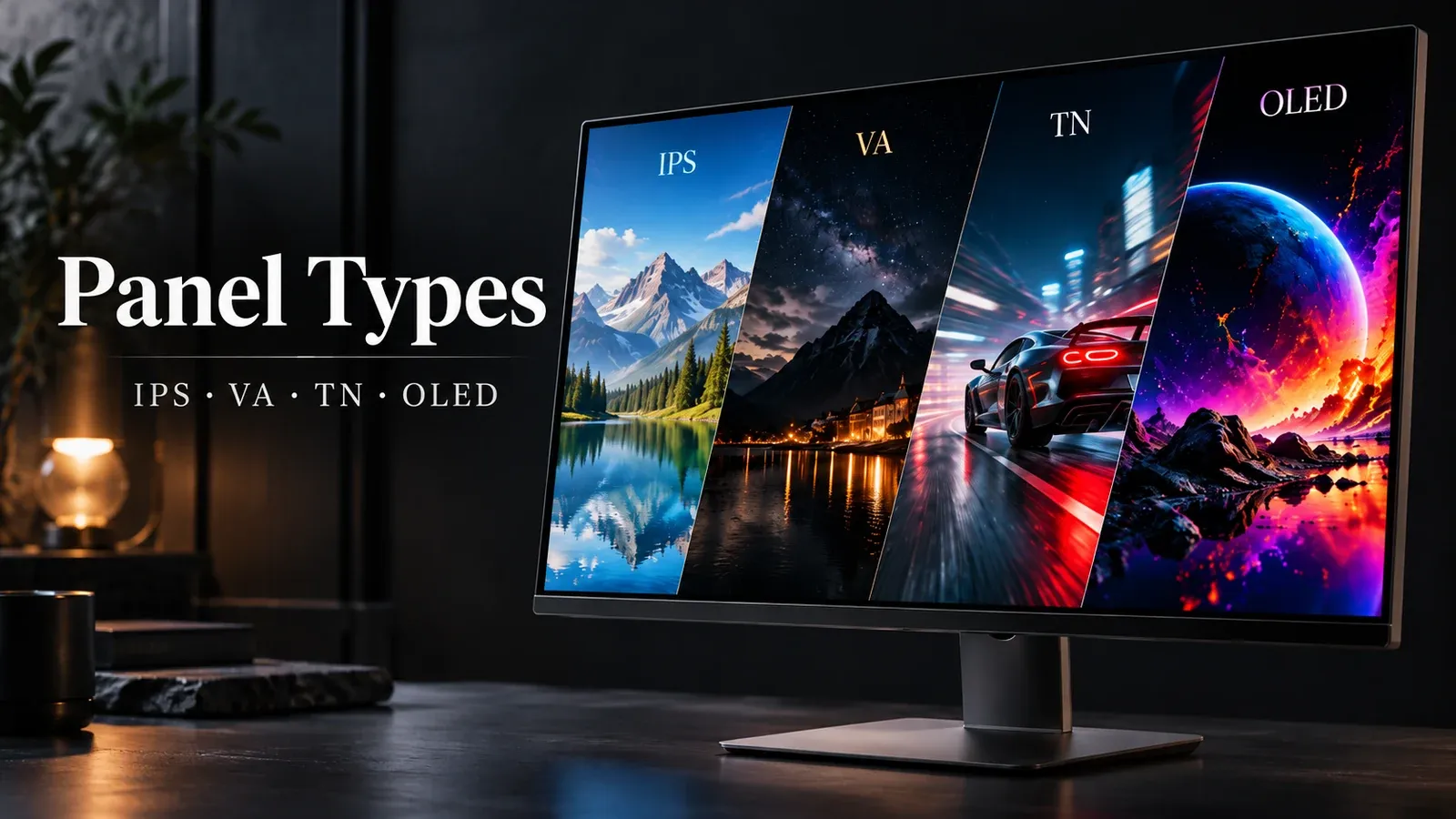
IPS, VA and TN are LCDs. On an OLED, every pixel makes its own light.
The numbers cover the official specs of current models from major brands.
- IPS: the liquid crystals lie parallel to the screen. Contrast is 1,000:1–1,500:1 and max refresh is 100Hz–180Hz
- VA: the highest contrast among the LCDs, at 3,000:1–5,000:1. Max refresh is 165Hz–280Hz
- TN: only 24.1-inch 1080p models turned up. Max refresh is 280Hz–600Hz
- OLED: contrast is 1,000,000:1–1,500,000:1 and max refresh is 240Hz–360Hz. BenQ says burn-in, a lingering image, is more likely
How to check a spec sheet
Look for these four things on the spec sheet of any monitor you’re considering.
- Panel type. The “panel” line says IPS, VA, TN or OLED. “Fast IPS” and “Rapid VA” are maker names for the same types
- How contrast is labeled. Compare “typical”, “static” or “native” numbers with each other. Keep “dynamic” numbers separate
- Viewing angle condition. “CR≥10” means the angle where contrast drops to 10:1. Among current models from major brands, IPS and VA both list 178°/178°
- How response time is measured. GtG and MPRT are different numbers, so compare like with like
Black level is white brightness divided by contrast. On the published numbers, at the same white brightness, a VA black is 1/2 to 1/5 the brightness of an IPS black. Those are maker claims, so what you see may not match the math.
Reading viewing angle and response time numbers
- Viewing angle: Among current models from major brands, the viewing angle spec is 178°/178° on every IPS, VA and OLED model compared, so it doesn’t tell them apart. EIZO says the number doesn’t describe brightness or color shift from an angle
- Response time: Among current models from major brands, GtG and MPRT response times measure different things, so only same-method numbers can be compared. 3 models list MPRT only. GtG is how long a pixel takes to switch from one gray to another. MPRT expresses motion blur as a time
- OLED response time: every OLED model compared lists 0.03 ms (GtG), which is under 1/6 the shortest LCD GtG
OLED burn-in warranty by maker and country
This table shows what each maker’s warranty and product pages said. A product page covers only the model on that page.
| Maker | Japan | US |
|---|---|---|
| Dell (Alienware) | Up to 3 years, including burn-in | Up to 3 years, including burn-in |
| ASUS (ROG) | 3 years; the Japanese page says “including panel burn-in” in English | 3 years, including burn-in |
| LG | 2 years, including burn-in | 2 years; burn-in coverage isn’t stated |
| MSI | 3 years; burn-in coverage isn’t stated | 3 years, including burn-in |
| Samsung | No official sales or warranty page found | Select models: 3 years, including burn-in. Commercial use and misuse excluded |
| GIGABYTE | 3 years, including burn-in | Product page: 3 years incl. burn-in. Warranty page: OLED 1 year, burn-in repairs paid — they conflict |
If you’ll use an OLED for office work, pick a maker that covers burn-in and read the years and conditions.
Makers warn that static images left on screen for long stretches can burn in. None publishes how many hours it takes, so that isn’t covered here.
Picks by use
These come from current models from major brands, limited to new listings on Amazon.com sold by Amazon or the maker. Each has 100 or more ratings and at least 4 stars.
Amazon.com listings of two AOC and three ZOWIE models weren’t checked, so they aren’t picks. Among the other models checked, each pick is the cheapest with shipping. Prices and ratings were checked in October 2026, and none was tested in person.
Check the price before you buy.
Office work, IPS
Movies and games in a dark room, VA
- Competitive FPS, TN: none confirmed
No Amazon.com listing was confirmed for one TN model, the ASUS ROG Swift Pro PG248QP. The Amazon.com listings of the other three weren’t checked.
OLED with burn-in coverage stated on the maker’s US page
FAQ
IPS or VA: which is better?
VA if you watch movies or play games in a dark room, IPS if you mostly work or sit off to the side. Stated contrast among current models from major brands is 3,000:1–5,000:1 for VA and 1,000:1–1,500:1 for IPS.
Is the viewing angle the same on IPS and VA?
On paper, yes. Among current models from major brands, the viewing angle spec is 178°/178° on every IPS, VA and OLED model compared, so it doesn’t tell them apart.
EIZO says the number doesn’t describe brightness or color shift from an angle, and that among LCDs (IPS, VA, TN) IPS shifts the least. There is no source comparing OLED, so it isn’t covered.
Can you compare response times in GtG and MPRT?
No. Among current models from major brands, GtG and MPRT response times measure different things, so only same-method numbers can be compared. 3 models list MPRT only.
The same model can also list a different GtG in each mode.
Does the warranty cover OLED burn-in?
On the 6 makers’ warranty pages checked in October 2026, LG and MSI state burn-in coverage on only one of the two countries’ pages checked. The other page says nothing either way, so whether the actual coverage differs is unconfirmed.
Samsung’s Japan page was not found, so it is unconfirmed; GIGABYTE’s US pages conflict. Coverage differs by country, and some countries’ pages say nothing.
Check the warranty page for your country before you buy.
Data and formulas used (for verification)
How this was checked: Specs come from maker spec pages, manuals and user guides, checked in October 2026. Some pages are for other countries. Everything was checked twice, and pages that could only be read once were opened again. The only calculation is the black-level ratio (black = white ÷ contrast). IPS corner glow, VA dark smearing and OLED text fringing aren’t covered, because no maker source was found. Guides: EIZO viewing angle, EIZO response time, BenQ OLED, Samsung. Warranty pages: Dell JP, Dell US, ASUS JP, ASUS US, LG JP, LG US, MSI JP, MSI US, Samsung JP, Samsung US, GIGABYTE JP, GIGABYTE US. Spec pages: Dell 1, Dell 2, Dell 3, BenQ 1, BenQ 2, ZOWIE 1, ZOWIE 2, ZOWIE 3, ASUS 1, ASUS 2, LG 1, LG 2, LG 3, MSI 1, MSI 2, MSI 3, MSI 4, MSI 5, AOC 1, AOC 2, Samsung, GIGABYTE.
Method
- Population: spec sheets of 23 models (IPS, VA, TN, OLED) from the makers’ own spec pages and manuals. Size, resolution, max refresh rate, contrast, viewing angle and response time are used as published
- Each panel’s range is the minimum to maximum of the models checked. Contrast uses only typical, static and native labels; the one model labeled dynamic is left out of the range
- Black level = white level ÷ contrast. At the same white level, a VA black is (IPS contrast ÷ VA contrast) times an IPS black. The range comes from the min/max combinations and is checked to be whole numbers
- GtG and MPRT are treated as different measurements and compared only like with like. The ratio between the shortest LCD GtG and the OLED 0.03 ms is rounded down and shown as ‘under 1/N’
- Burn-in warranty is classified from each maker’s Japan and US warranty and product pages (stated, stated in English only, not stated, no official page, pages conflict). Not stated is never read as not covered. A product-page entry applies to the model on that page
- The auto-refresh interval in days is Dell’s 1,500 hours ÷ 8 hours a day (assumed), rounded down
- Picks use Amazon listings checked on 2026-10-07 (amazon.co.jp for Japan, amazon.com for the US): new, sold by Amazon or the maker, 100+ ratings, 4+ stars, no review-checker warning, not an import; cheapest with shipping wins. US listings of two AOC and three ZOWIE models were not checked because amazon.com would not open
- No unit was tested, so nothing is said about how the screens look
Official values used
| Item | Value | Source | Checked |
|---|---|---|---|
| Dell S2725DS specs | (stated in a Japanese-language source) | dl.dell.com User’s Guide 2025-03 Rev. A01: IPS, 100 Hz, 1500 to 1 (typical), 178° (typical), | 2026-10-07 |
| Dell S2725DSM specs | (stated in a Japanese-language source) | dell.com | 2026-10-07 |
| BenQ GW2790 specs | panel: IPS / label: IPS / size: 27 / res: 1920×1080 / hz: 100 / cr: 1300 / cr_label: native / va: [178,178] / va_cond: true / rt: [“ms”:5,“method”:“GtG”] | benq.com Native contrast 1300:1, Viewing Angle (L/R) (CR=10) 178°/178°, Response Times (G | 2026-10-07 |
| ASUS TUF Gaming VG27AQ3A specs | panel: IPS / label: Fast IPS / size: 27 / res: 2560×1440 / hz: 180 / cr: 1000 / cr_label: typical / va: [178,178] / va_cond: true / rt: [“ms”:1,“method”:“GtG”] | asus.com Fast IPS, 180Hz, 1000:1, 1ms (GTG), Viewing Angle (CR≧10) 178°/178° | 2026-10-07 |
| LG 27GS75Q-B specs | (stated in a Japanese-language source) | lg.com | 2026-10-07 |
| MSI MAG 275QF specs | (stated in a Japanese-language source) | storage-asset.msi.com Rapid IPS, 180Hz, 0.5ms (GtG, Min.), 1000:1 (Typ.), 178°(H)/178°(V), Adobe RGB / | 2026-10-07 |
| BenQ MOBIUZ EX2710R specs | panel: VA / label: VA / size: 27 / res: 2560×1440 / hz: 165 / cr: 3000 / cr_label: native / va: [178,178] / va_cond: true / rt: [“ms”:1,“method”:“MPRT”] | benq.com VA 1000R, 165Hz, Native Contrast 3000:1, Viewing Angle (CR=10) 178°/178°, Respon | 2026-10-07 |
| LG 27GS60QC-B specs | (stated in a Japanese-language source) | lg.com | 2026-10-07 |
| MSI MAG 27C6X specs | panel: VA / label: VA / size: 27 / res: 1920×1080 / hz: 250 / cr: 3000 / cr_label: typical / va: [178,178] / va_cond: false / rt: [“ms”:1,“method”:“MPRT”] | storage-asset.msi.com VA Curve 1500R, 250Hz (OC), 1ms (MPRT), 3000:1 (Typ.), 178°(H)/178°(V) | 2026-10-07 |
| MSI MAG 275CQRF QD E2 specs | (stated in a Japanese-language source) | storage-asset.msi.com MAG 275CQRF QD E2: Rapid VA Curve 1500R, 180Hz, 0.5ms (GtG, Min.), 5000:1 (Typ.) | 2026-10-07 |
| AOC CQ27G4X specs | panel: VA / label: Fast VA / size: 27 / res: 2560×1440 / hz: 180 / cr: 4000 / cr_label: static / va: [178,178] / va_cond: true / rt: [“ms”:1,“method”:“GtG”,“ms”:0.5,“method”:“MPRT”] | aoc.com Fast VA 1500R, 180 Hz, STATIC CONTRAST RATIO 4000:1, VIEWING ANGLE (CR10) 178/17 | 2026-10-07 |
| AOC C27G4ZH specs | panel: VA / label: VA / size: 27 / res: 1920×1080 / hz: 280 / cr: 3000 / cr_label: static / va: [178,178] / va_cond: true / rt: [“ms”:0.3,“method”:“MPRT”] | aoc.com | 2026-10-07 |
| ASUS ROG Swift Pro PG248QP specs | panel: TN / label: TN / size: 24.1 / res: 1920×1080 / hz: 540 / cr: 1000 / cr_label: typical / va: [170,160] / va_cond: true / rt: [“ms”:0.2,“method”:“GtG”] | rog.asus.com | 2026-10-07 |
| BenQ ZOWIE XL2546X+ specs | panel: TN / label: TN / size: 24.1 / res: 1920×1080 / hz: 280 / cr: 1000 / cr_label: native / va: null / va_cond: false / rt: [] | zowie.benq.com | 2026-10-07 |
| BenQ ZOWIE XL2566X+ specs | panel: TN / label: TN / size: 24.1 / res: 1920×1080 / hz: 400 / cr: 1000 / cr_label: native / va: null / va_cond: false / rt: [] | zowie.benq.com | 2026-10-07 |
| BenQ ZOWIE XL2586X+ specs | panel: TN / label: TN / size: 24.1 / res: 1920×1080 / hz: 600 / cr: 1000 / cr_label: native / va: null / va_cond: false / rt: [] | zowie.benq.com | 2026-10-07 |
| LG 27GS95QE-B specs | panel: OLED / label: OLED / size: 26.5 / res: 2560×1440 / hz: 240 / cr: 1500000 / cr_label: typical / va: [178,178] / va_cond: true / rt: [“ms”:0.03,“method”:“GtG”] | lg.com Contrast Ratio 1.5M:1 (Typ.), Response Time (GTG) 0.03ms, 240Hz, DCI-P3 98.5% (C | 2026-10-07 |
| ASUS ROG Strix OLED XG27AQDMG specs | panel: OLED / label: WOLED / size: 26.5 / res: 2560×1440 / hz: 240 / cr: 1500000 / cr_label: typical / va: [178,178] / va_cond: true / rt: [“ms”:0.03,“method”:“GtG”] | rog.asus.com | 2026-10-07 |
| Alienware AW2725DF specs | panel: OLED / label: QD-OLED / size: 26.7 / res: 2560×1440 / hz: 360 / cr: 1500000 / cr_label: dynamic / va: [178,178] / va_cond: false / rt: [“ms”:0.03,“method”:“GtG”] | dell.com Panel Technology Quantum Dot OLED, 360Hz, Dynamic Contrast Ratio 1,500,000:1, 0. | 2026-10-07 |
| MSI MAG 271QPX QD-OLED E2 specs | panel: OLED / label: QD-OLED / size: 26.5 / res: 2560×1440 / hz: 240 / cr: 1500000 / cr_label: typical / va: [178,178] / va_cond: false / rt: [“ms”:0.03,“method”:“GtG”] | us.msi.com QD-OLED, 240Hz, 0.03ms (GtG), 1500000:1 (Typ.), 178°(H)/178°(V) | 2026-10-07 |
| MSI MAG 271QP QD-OLED X28 specs | panel: OLED / label: QD-OLED / size: 26.5 / res: 2560×1440 / hz: 280 / cr: 1500000 / cr_label: typical / va: [178,178] / va_cond: false / rt: [“ms”:0.03,“method”:“GtG”] | us.msi.com QD-OLED, 280Hz, 0.03ms (GTG), 1500000:1 (Typ.), 178°(H)/178°(V) | 2026-10-07 |
| Samsung Odyssey OLED G6 G60SD specs | panel: OLED / label: OLED / size: 27 / res: 2560×1440 / hz: 360 / cr: 1000000 / cr_label: static / va: [178,178] / va_cond: false / rt: [“ms”:0.03,“method”:“GtG”] | samsung.com Contrast Ratio Static 1,000,000:1, 0.03ms(GTG), 360Hz, 178°(H)/178°(V) | 2026-10-07 |
| GIGABYTE MO27Q28G specs | panel: OLED / label: WOLED / size: 27 / res: 2560×1440 / hz: 280 / cr: 1500000 / cr_label: typical / va: [178,178] / va_cond: false / rt: [“ms”:0.03,“method”:“GtG”] | gigabyte.com Panel Type WOLED, 280Hz, 0.03ms GTG, Contrast Ratio (Typ.) 1.5M:1, 178°(H)/178°( | 2026-10-07 |
| Dell Japan burn-in warranty | years: 3 / covered: yes / upto: true | dell.com | 2026-10-07 |
| Dell US burn-in warranty | years: 3 / covered: yes / upto: true | dell.com QD–OLED panel technology is limited to a 3-year maximum warranty term, includes | 2026-10-07 |
| ASUS Japan burn-in warranty | years: 3 / covered: yes_en_only | rog.asus.com | 2026-10-07 |
| ASUS US burn-in warranty | years: 3 / covered: yes | rog.asus.com Warranty: 3 years (including panel burn-in) | 2026-10-07 |
| LG Japan burn-in warranty | years: 2 / covered: yes | lg.com | 2026-10-07 |
| LG US burn-in warranty | years: 2 / covered: not_stated | lg.com | 2026-10-07 |
| MSI Japan burn-in warranty | years: 3 / covered: not_stated | storage-asset.msi.com | 2026-10-07 |
| MSI US burn-in warranty | years: 3 / covered: yes | us.msi.com WARRANTY 3 years (including panel burn-in) | 2026-10-07 |
| Samsung Japan burn-in warranty | years: null / covered: not_sold | samsung.com | 2026-10-07 |
| Samsung US burn-in warranty | years: 3 / covered: yes / excl: true / hub: true | samsung.com Burn-in at normal usage covered within warranty. (But, not covered for Commercia | 2026-10-07 |
| GIGABYTE Japan burn-in warranty | years: 3 / covered: yes | gigabyte.com | 2026-10-07 |
| GIGABYTE US burn-in warranty | years: 3 / covered: conflict | gigabyte.com Warranty 3 years (including panel burn-in) | 2026-10-07 |
| Dell pixel refresh interval | four hours | dell.com Pixel Refresh: activated automatically when the monitor is used for at least fou | 2026-10-07 |
| Dell panel refresh interval | 1,500 hours | dell.com Panel Refresh: activated automatically when the accumulated usage time exceeds t | 2026-10-07 |
| ASUS OLED cleaning interval | four hours | asus.com recommends pixel cleaning every four hours; process about 6 minutes | 2026-10-07 |
| Dell pixel refresh duration | about 6 to 8 minutes | dell.com The process takes approximately 6 to 8 minutes to complete. | 2026-10-07 |
| Dell panel refresh duration | about an hour | dell.com The process takes approximately an hour to complete. | 2026-10-07 |
| ASUS cleaning duration | about 6 minutes | asus.com The process will take approximately 6 minutes. | 2026-10-07 |
| Samsung panel guide | Samsung panel guide | samsung.com IPS: liquid crystals arranged parallel to the screen; OLED: individually lit pix | 2026-10-07 |
| DisplayHDR True Black 400 black-level limit | 0.0005 cd/m² | displayhdr.org DisplayHDR True Black: Dual Corner Box Test maximum black 0.0005 cd/m² (all True | 2026-10-07 |
| DisplayHDR 400 black-level limit | 0.4 cd/m² | displayhdr.org DisplayHDR 400: maximum black 0.4 cd/m² | 2026-10-07 |
| Static-image burn-in warning | static image burn-in warning | asus.com Image persistence, or burn-in, on an OLED display can occur if a static high-con | 2026-10-07 |
| BenQ OLED explainer | OLED explanation | benq.com the individual pixel control of OLEDs leaves them more vulnerable to image reten | 2026-10-07 |
| GtG and MPRT definitions | GtG / MPRT definitions | eizo.com Gray-to-gray: the time it takes a pixel to change from one gradation of gray to | 2026-10-07 |
| Contrast ratio at the viewing-angle limit (CR) | 10 | eizo.com spec viewing angle = angle until the contrast ratio drops to 10:1 or 5:1; does n | 2026-10-07 |